



We weren’t in Haiti on January 1st to celebrate Haitian Independence Day, so we had plans to celebrate it with the Haitian and US American staff together on the first weekend after we returned in January. Well … other things happened … and we just never got around to it –until today!
Haiti celebrates its independence from France on January 1 each year, because after expelling the last French troops in November of 1803, Jean Jacques Dessalines, the revolutionary leader and first president, declared that independence would be proclaimed and celebrated on the first day of the new year. That day, in Cap Haitian, the city on the north coast with the citadel from which the last French ships had sailed the previous November, Dessalines proclaimed the Haitian Declaration of Independence. Somewhat ironically – or maybe tragically – the document was written in French, the language of Haiti’s colonial oppressors, since the descendants of Africans from so many different places did not share a common language of their own. It’s a shocking document, both for the striking resemblance it bears to the language and sentiments of the American Declaration of Independence written about thirty years before, as well as for the very un-Jeffersonian anger and violence which permeates it. Promises to “swear to the entire universe, to posterity, to ourselves, to renounce forever to France, and to die rather than to live under its domination,” are followed by the not so veiled threat to “pursue forever the traitors and the enemies of [our] independence.” Needless to say, after fifteen years of the most horrific violence, this declaration of independence was not sealed with handshakes and the flourish of a quill pen. It was sealed with blood and promises of retribution.
Along with the official pronouncement of independence, Dessalines led the people in a symbolic reclaiming of their rights as free people. That morning, he ate squash soup, the French delicacy long refused to the slaves, and invited the people gathered to do the same. Since then, the tradition in Haiti and in Haitian homes in the US is to greet the new year not with champagne toasts and wild parties, but with family and friends gathered around an early morning breakfast of squash soup. For years teaching in Cambridge, I have heard Haitian kids talk about their unique New Years tradition, and have occasionally enjoyed a Tupperware bowl full of squash soup leftovers on January 3 when school begins again, and I have always wanted to try making it myself.
This morning Benoit and I met in the kitchen at about 4:15. Unfortunately the electricity was out, as it often is at that time of the morning after the batteries have run out of juice and before the sun has come up to get the solar power going again. He chopped open the GIANT green squash, which looks like an orange pumpkin inside, and scooped out the guts. I got to work washing, peeling, and chopping sweet potatoes, regular potatoes, turnips, carrots, onions and garlic. As we worked, more helpers appeared, we drank two pots of coffee, and listened to Wyclef Jean. We boiled the squash, then pureed it – skin and all – in a blender. Benoit had prepared the meat before in the traditional way – by soaking it in citrus juices, then boiling it with garlic and scallions. We then boiled the pureed squash, and added the veggies, meat, macaroni, and lots of salt. (It wouldn’t be Haitian food without lots of salt!) By about 6:45 we were ready and a much larger than usual crowd gathered for an early Saturday morning breakfast. We had so much food that we were able to share it with some of the neighbors – men who were on campus to help with a building project, and some of the women who come to wash the clothes of those of us who are utterly incapable of doing so ourselves. We wished each other Bon Anè, and declared it the new year of 2010 ½ … and frankly, given all that’s happened here since January, it felt kind of good to turn the page of the calendar, even if it was to an imaginary new year.
Saturday, May 8, 2010


Fahrenheit 451
Nobody likes the idea of burning books. I know I certain;y don't, but sometimes you just have to.
Working for so long in schools, I have had lots of opportunities to be irritated by the “donations” that people make to the “less fortunate.” They pack their boxes full of the crap they don’t want anymore, drop it off at the door of a local charity, pat themselves on the back for their generosity and take a little tax write-off. Then, the school or charity has to figure out what to do with the donations. Don’t get me wrong, oftentimes people donate wonderful, useful things to schools. But too often they really just donate the crap that they don’t want and don’t know how to get rid of. So, I’ve had to face the question of what to do with unwanted, outdated, irrelevant books. My answer is always to resist the temptation to “save them because maybe some day someone will want them.” No, if we can’t use it right now, then I choose clean, organized storage spaces over the unlikely possibility that some mythical, future teacher will find a good use for the materials that all the actual teachers of the present think are useless. At PHA, this has meant that I have often led parades of boxes of books to the dumpster, or more recently to the curb where a non-profit recycling company picks them up. In Haiti, it’s not that simple.
On Thursday, a huge truck from Food for the Poor pulled up on Santo 5 and I watched as boxes and boxes of mysterious donations walked in the door of the school. Food for the Poor donates a lot of food to LCS, and this year they also provided us with 12 gently used, well refurbished computers for the kids’ computer lab. But in exchange for all the useful things they bring us, sometimes they bring us crap. I think I’ve written about the cases and cases of tiny leather cowboy boots, and the rejected cosmetics for white people that have appeared on our doorstep in the past. This time it was about a hundred boxes of English curriculum materials from some elementary school district in Ohio. There were a few boxes of reading anthologies, fifteen copies of three different books, which will be incredibly useful for the English teachers working with our youngest students. But beyond these ten boxes, there were 90 of teachers’ editions, answer booklets, catalogues, glossy professional development guides, and lots of other propaganda for the publishers of the “Storytown” reading program. The part when I really went through the roof was when I opened the box full of cardboard sleeves that looked like they contained some kind of DVD or CD-Rom … but no … oh wait … they were all empty. Thanks for that.
We sorted through the things we can legitimately use and then had to face that awkward questions about what we should do with the rest of it? I was a proponent of burning it, the way we burn all our trash around here. But the whole day as we sorted all the brightly colored spiral bound teachers’ editions on tables outside on the driveway, the kids were watching curiously as they passed by. They love books … any books … but especially books in English. I tried to show some that these weren’t books for reading – some were literally catalogues of additional curriculum materials. But as we started walking wheelbarrows full of materials back to the incinerator, the kids were begging us not to. So we stopped. What’s worse, giving poor kids useless stuff that will probably end up contributing to the momentous trash problem in this country, or the scandal of burning books in a school full of kids who are hungry to learn? We opted for the lesser evil behind door number 1.
So on Friday afternoon we set up tables by the front gate, and as kids were dismissed for the weekend, they took whatever they wanted. And they wanted all of it. Actually, despite our best efforts at order and discipline, they pretty much stampeded the tables to get what they could. Situations like this always make me – and pretty much everyone else who comes from cultures of wealth and privilege – really uncomfortable. When you’re so accustomed to not having anything, it doesn’t matter what the free thing being offered is – you’ll pretty much run over a kid half your size to get your hands on it because you know it’s not going to be there tomorrow.
By three o’clock the kids were gone and so were the unwanted books. We were left to burn the cardboard boxes and contemplate the weirdly complex ethical decisions that Haiti forces us to make. Sometimes the right answer is so obvious, and sometimes it’s a million shades of gray.
Working for so long in schools, I have had lots of opportunities to be irritated by the “donations” that people make to the “less fortunate.” They pack their boxes full of the crap they don’t want anymore, drop it off at the door of a local charity, pat themselves on the back for their generosity and take a little tax write-off. Then, the school or charity has to figure out what to do with the donations. Don’t get me wrong, oftentimes people donate wonderful, useful things to schools. But too often they really just donate the crap that they don’t want and don’t know how to get rid of. So, I’ve had to face the question of what to do with unwanted, outdated, irrelevant books. My answer is always to resist the temptation to “save them because maybe some day someone will want them.” No, if we can’t use it right now, then I choose clean, organized storage spaces over the unlikely possibility that some mythical, future teacher will find a good use for the materials that all the actual teachers of the present think are useless. At PHA, this has meant that I have often led parades of boxes of books to the dumpster, or more recently to the curb where a non-profit recycling company picks them up. In Haiti, it’s not that simple.
On Thursday, a huge truck from Food for the Poor pulled up on Santo 5 and I watched as boxes and boxes of mysterious donations walked in the door of the school. Food for the Poor donates a lot of food to LCS, and this year they also provided us with 12 gently used, well refurbished computers for the kids’ computer lab. But in exchange for all the useful things they bring us, sometimes they bring us crap. I think I’ve written about the cases and cases of tiny leather cowboy boots, and the rejected cosmetics for white people that have appeared on our doorstep in the past. This time it was about a hundred boxes of English curriculum materials from some elementary school district in Ohio. There were a few boxes of reading anthologies, fifteen copies of three different books, which will be incredibly useful for the English teachers working with our youngest students. But beyond these ten boxes, there were 90 of teachers’ editions, answer booklets, catalogues, glossy professional development guides, and lots of other propaganda for the publishers of the “Storytown” reading program. The part when I really went through the roof was when I opened the box full of cardboard sleeves that looked like they contained some kind of DVD or CD-Rom … but no … oh wait … they were all empty. Thanks for that.
We sorted through the things we can legitimately use and then had to face that awkward questions about what we should do with the rest of it? I was a proponent of burning it, the way we burn all our trash around here. But the whole day as we sorted all the brightly colored spiral bound teachers’ editions on tables outside on the driveway, the kids were watching curiously as they passed by. They love books … any books … but especially books in English. I tried to show some that these weren’t books for reading – some were literally catalogues of additional curriculum materials. But as we started walking wheelbarrows full of materials back to the incinerator, the kids were begging us not to. So we stopped. What’s worse, giving poor kids useless stuff that will probably end up contributing to the momentous trash problem in this country, or the scandal of burning books in a school full of kids who are hungry to learn? We opted for the lesser evil behind door number 1.
So on Friday afternoon we set up tables by the front gate, and as kids were dismissed for the weekend, they took whatever they wanted. And they wanted all of it. Actually, despite our best efforts at order and discipline, they pretty much stampeded the tables to get what they could. Situations like this always make me – and pretty much everyone else who comes from cultures of wealth and privilege – really uncomfortable. When you’re so accustomed to not having anything, it doesn’t matter what the free thing being offered is – you’ll pretty much run over a kid half your size to get your hands on it because you know it’s not going to be there tomorrow.
By three o’clock the kids were gone and so were the unwanted books. We were left to burn the cardboard boxes and contemplate the weirdly complex ethical decisions that Haiti forces us to make. Sometimes the right answer is so obvious, and sometimes it’s a million shades of gray.
Sunday, April 25, 2010
The Home Stretch
The kids have been so worried about when school will end. When the government officially reopened schools in April, the word eventually came down that the national exams would be in August instead of June, and that schools should continue through the end of July. Well, for the kids here who never actually left even when we were having “unofficial” school, that news came as a pretty terrible blow, not only for the prospect of having to be in class instead of watching the World Cup matches in June, but also for sitting in the 100 degree blue tents in the hottest part of the summer. After much deliberation, the LCS administration decided that we will have graduation as scheduled at the beginning of June, but that the younger classes will all continue classes through the end of June, in order to give all of their teachers an opportunity to complete fair evaluations of their work over a reasonable period of time. While the volunteers will finish our classes in early June and then go home, the Haitian teachers will continue theirs until the end of the month, and the kids will stay at school without us. It’s absolutely the right decision, even though it’s not particularly popular with anyone. But isn’t that usually the case with most absolutely right decisions?
So now I’m looking at my last six weeks here trying to figure out what I need to be working on. Obviously I have all of my own classes and exams to finish, but I suddenly have this almost panicked sense of wanting to get so many other things done. I’m working with the volunteers on documenting our curriculum more formally and in a more uniform manner than it has ever been documented before, so that future volunteers are left with a somewhat more clear roadmap of what has been done, and what ought to be done in the future. I’m working on the schedule for the month of June, which will look a bit different without the ten American teachers. A few of us are working on an LCS recipe book to document how to make our favorite meals for 30. I’m so excited that five of the ten volunteers have chosen to stay for a second year next year, but unfortunately the five who like to cook are the ones leaving, so we’re trying to help them out as much as we can. Other than that, I’m trying to enjoy the kids and the mangoes and all the uniquely Haitian experiences that happen here every day – the wonderful, the absurd and even the incredibly irritating ones.
I will be returning to Boston on Sunday June 6th the day after LCS graduation. Unfortunately my flight will put me in about an hour or two late for the PHA graduation that Sunday afternoon, so I’ll miss the big day for that group of kids whom I’ve known since they were eleven. I’m so happy to be returning to Boston and PHA, a community that I love so much, in which I have essentially grown up as an educator over the past eight years. My year away from PHA has provided me with the space and perspective I needed to decide to pursue a more formal leadership role within the school. The school is undergoing an important transition right now, reuniting the middle school and high school on the same campus, so this was a great opportunity for me to make a career shift. Next year I’ll serve as an assistant principal with primary responsibility for the 11th and 12th grade students, as well as lots of work with teachers and parents. While it’s totally bizarre for me to imagine a life in school that’s not centered around my own classroom teaching, I’m excited for this new challenge. I think there are parts of this job that I’ll be really good at, and parts that will be really hard for me, and I so look forward to that experience. Being in Haiti this year has reminded me how much I love learning new things everyday, and having to think on my feet and adapt to whatever challenges the day throws my way. And I’m sure that some of the things I’ve learned here this year will help me to navigate the challenges ahead. At least those PHA kids won’t be able to get away with saying bad stuff in Kreyol around me!
So now I’m looking at my last six weeks here trying to figure out what I need to be working on. Obviously I have all of my own classes and exams to finish, but I suddenly have this almost panicked sense of wanting to get so many other things done. I’m working with the volunteers on documenting our curriculum more formally and in a more uniform manner than it has ever been documented before, so that future volunteers are left with a somewhat more clear roadmap of what has been done, and what ought to be done in the future. I’m working on the schedule for the month of June, which will look a bit different without the ten American teachers. A few of us are working on an LCS recipe book to document how to make our favorite meals for 30. I’m so excited that five of the ten volunteers have chosen to stay for a second year next year, but unfortunately the five who like to cook are the ones leaving, so we’re trying to help them out as much as we can. Other than that, I’m trying to enjoy the kids and the mangoes and all the uniquely Haitian experiences that happen here every day – the wonderful, the absurd and even the incredibly irritating ones.
I will be returning to Boston on Sunday June 6th the day after LCS graduation. Unfortunately my flight will put me in about an hour or two late for the PHA graduation that Sunday afternoon, so I’ll miss the big day for that group of kids whom I’ve known since they were eleven. I’m so happy to be returning to Boston and PHA, a community that I love so much, in which I have essentially grown up as an educator over the past eight years. My year away from PHA has provided me with the space and perspective I needed to decide to pursue a more formal leadership role within the school. The school is undergoing an important transition right now, reuniting the middle school and high school on the same campus, so this was a great opportunity for me to make a career shift. Next year I’ll serve as an assistant principal with primary responsibility for the 11th and 12th grade students, as well as lots of work with teachers and parents. While it’s totally bizarre for me to imagine a life in school that’s not centered around my own classroom teaching, I’m excited for this new challenge. I think there are parts of this job that I’ll be really good at, and parts that will be really hard for me, and I so look forward to that experience. Being in Haiti this year has reminded me how much I love learning new things everyday, and having to think on my feet and adapt to whatever challenges the day throws my way. And I’m sure that some of the things I’ve learned here this year will help me to navigate the challenges ahead. At least those PHA kids won’t be able to get away with saying bad stuff in Kreyol around me!
2012
I would like to thank the History Channel and Sony Pictures for perpetuating the absurd prophecy that the world will end in December in 2012. That’s going over real well right now in a country full of traumatized people who tend to lean toward apocalyptic conspiracy theories anyway, and who are now obviously particularly susceptible to such ideas. Thanks for that. I’m really enjoying having this conversation with a different kid every day.
Post Earthquake Haiku Therapy
About two weeks after the earthquake, I decided to play one of my favorite games … the community Haiku. It works like this: I write the first two lines of a Haiku, and everyone else writes his or her own last line. This “post earthquake haiku therapy” has been on our wall ever since, and I still half smile and half cringe every time I read it.
The first two lines are:
Seven point zero
What the hell is going on?
The five syllable final lines are as follows … with a little explanation of each person’s earthquake experience:
Betsy: Get under the couch!
I’ve already explained that my somewhat appropriate and sort of insane instinct was to climb under the couch in our common room to wait for the shaking to stop
Mary: Should we not get out?
Mary was with me and Kristen upstairs, and while her inclination to get the hell out was probably better than mine to climb under the couch … we didn’t go anywhere.
Kristen: Please stop shaking now.
I’d say this one’s self explanatory
Elissa: Uh oh … coconuts!
She was outside walking among the mango and coconut trees and incredibly, her first thought was what would happen if one fell on her head. If you’ve never seen a coconut fall to the ground, it could kill you.
Peter: Incinerator?
He was outside dumping a wheelbarrow full of trash into the incinerator when the cinderblock walls starting moving. He thought the incinerator walls themselves were about to fall. Miraculously, only a few of the blocks actually did fall.
Samanthaa: Uh guys, get out now!
She was also near the incinerator with Peter and ran with the kids on the soccer field toward the center of the soccer field, away from the walls that were waving and crumbling.
Jon: Don’t push, pull instead.
Jon and Corey were making dinner in the kitchen and had a huge pot of water boiling on the stove. Amazingly, it didn’t completely fall off the stove. They ran for a doorway and Jon couldn’t figure out why he couldn’t get the door open …
Corey: Hold me Jon, I’m scared!
Corey the Guamanian is the only one of us who had any previous earthquake experience, so it was he who told Jon to get into a doorway.
Meg: I think we’re moving.
Meg was on the soccer field with the kids too.
John: hey guys, sorry I’m late!
John DiTillo wasn’t actually in Haiti on January 12th. He was a volunteer last year, and was safe at home in Hanibal, Missouri when the earthquake happened here. A month later, he had dropped everything at home and was back in Haiti. He’s picked up classes for volunteers who have since gotten involved in more time consuming outside of school projects. More importantly, he was a much needed shot of energy and enthusiasm at a time when we were getting pretty tired. Now he’s decided to stay on past June, and will return to LCS next fall as well. What a blessing.
About a month after the earthquake I started hearing an expression in Kreyol that sort of freaked me out a little at first, but which I have since come to understand and genuinely appreciate. One day in class I asked where a student was, and the response came, “anba dekonb” … under the rubble. I think she was really only in the bathroom or something. Subsequently, questions about “where’s your pen,” “has anyone seen my eraser,” and “where’s the truck” are all met with the same joking response … “under the rubble.” Now there’s even a Haitian DJ who mixed an upbeat tune that says, “put me under the rubble … pull me out from the rubble” and people around here sing it incessantly. It makes perfect sense to me now. Haitians are so accustomed to tragedy, but also love to laugh so much, that it’s only right that eventually there would be a collective national joke about the latest tragedy. We wrote a haiku, and they make morose jokes about being buried under the rubble. It’s the same thing really.
The first two lines are:
Seven point zero
What the hell is going on?
The five syllable final lines are as follows … with a little explanation of each person’s earthquake experience:
Betsy: Get under the couch!
I’ve already explained that my somewhat appropriate and sort of insane instinct was to climb under the couch in our common room to wait for the shaking to stop
Mary: Should we not get out?
Mary was with me and Kristen upstairs, and while her inclination to get the hell out was probably better than mine to climb under the couch … we didn’t go anywhere.
Kristen: Please stop shaking now.
I’d say this one’s self explanatory
Elissa: Uh oh … coconuts!
She was outside walking among the mango and coconut trees and incredibly, her first thought was what would happen if one fell on her head. If you’ve never seen a coconut fall to the ground, it could kill you.
Peter: Incinerator?
He was outside dumping a wheelbarrow full of trash into the incinerator when the cinderblock walls starting moving. He thought the incinerator walls themselves were about to fall. Miraculously, only a few of the blocks actually did fall.
Samanthaa: Uh guys, get out now!
She was also near the incinerator with Peter and ran with the kids on the soccer field toward the center of the soccer field, away from the walls that were waving and crumbling.
Jon: Don’t push, pull instead.
Jon and Corey were making dinner in the kitchen and had a huge pot of water boiling on the stove. Amazingly, it didn’t completely fall off the stove. They ran for a doorway and Jon couldn’t figure out why he couldn’t get the door open …
Corey: Hold me Jon, I’m scared!
Corey the Guamanian is the only one of us who had any previous earthquake experience, so it was he who told Jon to get into a doorway.
Meg: I think we’re moving.
Meg was on the soccer field with the kids too.
John: hey guys, sorry I’m late!
John DiTillo wasn’t actually in Haiti on January 12th. He was a volunteer last year, and was safe at home in Hanibal, Missouri when the earthquake happened here. A month later, he had dropped everything at home and was back in Haiti. He’s picked up classes for volunteers who have since gotten involved in more time consuming outside of school projects. More importantly, he was a much needed shot of energy and enthusiasm at a time when we were getting pretty tired. Now he’s decided to stay on past June, and will return to LCS next fall as well. What a blessing.
About a month after the earthquake I started hearing an expression in Kreyol that sort of freaked me out a little at first, but which I have since come to understand and genuinely appreciate. One day in class I asked where a student was, and the response came, “anba dekonb” … under the rubble. I think she was really only in the bathroom or something. Subsequently, questions about “where’s your pen,” “has anyone seen my eraser,” and “where’s the truck” are all met with the same joking response … “under the rubble.” Now there’s even a Haitian DJ who mixed an upbeat tune that says, “put me under the rubble … pull me out from the rubble” and people around here sing it incessantly. It makes perfect sense to me now. Haitians are so accustomed to tragedy, but also love to laugh so much, that it’s only right that eventually there would be a collective national joke about the latest tragedy. We wrote a haiku, and they make morose jokes about being buried under the rubble. It’s the same thing really.
Wednesday, April 7, 2010
Una Playa Bonita … y Una Presidente Por Favor!


On our first day at the resort near Santo Domingo, I kept laughing to myself thinking, “we are the ideal resort guests … because we will love EVERYTHING!” Did we throw a fit that our shower didn’t have any water for an hour or so? Nope. Were we annoyed that one of the restaurants was closed one night? Nope. We loved everything. The fancy lobby, the ocean view from our rooms (even though we had to crane our necks to the right a bit), the endless buffet, the waiters who came around and refilled our café con leche all morning, the free (I mean already paid for) cocktails … and the forks. Seriously, we were all just pretty excited to have total access to any kind of silverware we wanted at any moment of the day or night. At LCS our forks and spoons have the irritating habit of disappearing, so we end up eating spaghetti with spoons, and drinking soup with a quarter cup measuring cup. Needless to say, the endless supply of forks was pretty great. But mostly what we loved was the total relaxation of it. We didn’t have to do anything except enjoy the picturesque beach and the beautiful, friendly people. I’ve never done the “all inclusive” thing before, and I don’t think I would want to do it for a whole week, but for three days it was perfect.
After the resort we took the bus north to the Samana Peninsula, to a place called Playa Bonita. And yes, it was. There we stayed at a small hotel on a dirt road across the street from a very different, but equally beautiful beach. This one had rougher waves, but even softer sand. And there was no loud music, or people selling things, or free drinks … just the beach. We walked an hour into the little town nearby, bought sandwiches from an Italian grocery store, and rode on the backs of motorcycles back at night. We went on a horseback riding trip through mountain trails to a place called “cascada limon” where we jumped off a 30 foot ledge into the waterfall’s pool below. I can count on one hand the number of times I’ve ridden a horse in my life, and I’m SURE I’ve never been on a galloping horse. It was terrifying / awesome … but mostly awesome.
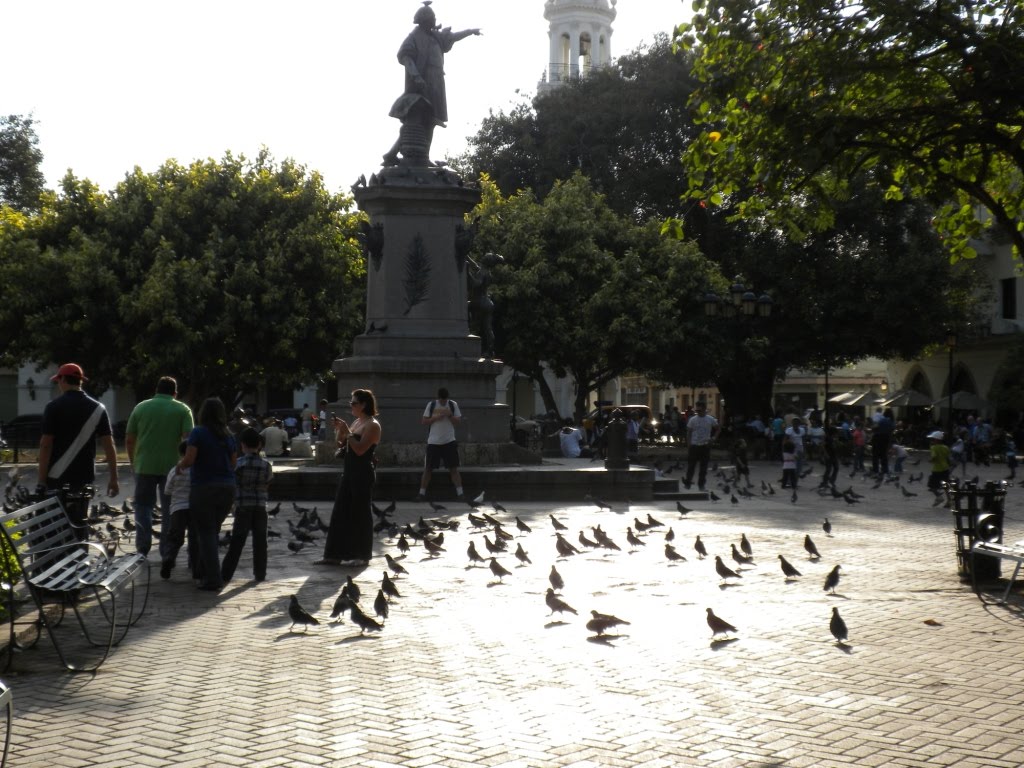
Then we scored a reasonably cheap taxi ride back to Santo Domingo (avoiding a two and half hour bus ride all together) and arrived in the capital at about noon on Friday. We stayed at a little hotel run by a German man in the zona colonial, and for the next three days I just kept thinking about Europe. There are cafes with outdoor seating, and people just sit there smoking for hours. There are motorcycles everywhere. Little kids chase pigeons in plazas in front of 500 year old churches. Only it was better than Europe because seriously, Dominicans are way more beautiful than Europeans, and it was a whole lot cheaper. We spent the days walking a lot, enjoying the freedom of being in a city. I drank lots of coffee drinks in outdoor cafes, and struck up conversations with anyone wearing a Red Sox of Yankees cap, which was lots of people.
Santo Domingo was lovely for the mix of uniquely Dominican things and the comforts of home. I went to Easter Mass at a tiny church with about 40 people in it, and instead of the Handel Alleluia and brass quintet (my usual Easter routine) there was a lady with a tambourine and about five nuns singing with her. A good reminder that, as much as I love the music, it’s not all about the music. Then for Easter dinner we did the only thing any self respecting Americans who have been in Haiti for 8 months would do … we went to McDonalds. I think a few of the boys almost cried with joy. I haven’t had a quarter pounder with cheese in years, but wow, that was tasty. Our last night, we planned to go watch the Red Sox and Yankees at a sports bar with a big screen TV, but instead stumbled upon a neighborhood dance party. We spent the evening with a few hundred people dancing Merengue and Bachata in the street while a live band and some old dudes (who could really sing) kept the crowd moving for hours. Instead of bar food we ate deep fried street food, but of course still enjoyed more than our share of the DR’s finest brew, Presidente. And much to my delight, there was a TV outside that was showing the Sox and Yankees, so all night long, I had lots of opportunities to trash talk in Spanish. How exactly do you say “Yankees suck!” in Spanish? Never quite nailed that one down. It was a perfect end to our ten day break.
The whole thing reminded me how much I love to travel. On this trip I spoke more Italian than I have in ten years (who knew there were so many Italians settling in the DR?) and I got to freak out lots of Haitians who did NOT expect the whitest person they’d ever seen to speak Spanish let alone Kreyol. I loved haggling with cab drivers, and negotiating very, VERY badly with an art dealer. Whatever. I don’t care if I overpaid. I love this painting and I feel pretty good about putting my money into the local economy. I love setting out for dinner with the plan to eat at a place recommended in a guide book only to find something way better on the way. It’s just all so fun. Can someone figure out how I can do that for a living?
Now we’re back to Haiti and LCS is up and running without missing a beat. Today, April 6, was the first official school day in Port au Prince since January 12th. The government encouraged the schools which are able to open, and there were kids in uniform all over town. We had 318 kids this morning, closer and closer to our pre-earthquake number. Today one of my absolute favorite kids was back to school for the first time. Rose Celine is about 17, and is one of the sweetest, smiley-est kids I’ve ever known. In the hours after the earthquake, hers was one of the terrified faces that drove home for me how serious this whole thing was. Gone was her smile – and the tears on her face and fear in her eyes is an image I’ll never forget. Then the next day she was gone, and I’ve wondered how she is for almost three months now. So I was so happy today to see her there in my first period Spanish class, looking a little overwhelmed but smiling nonetheless. Vacation was wonderful, but Rose Celine is back to school, so I better be here too!
Sunday, March 21, 2010
The Rainpocalypse


I know that people in the DC area lived through several feet of snow this winter, the so called snowpocalypse, and that my New England family and friends experienced 10 inches of rain last weekend and are still pumping out flooded basements. This morning, we had a rain phenomenon like nothing that has ever happened in my time here. It rained during school hours. Insert foreboding, dramatic music here.
The rainy season has begun again, which means that it rains almost every night at about 7 for a few hours, or for a while just before dawn. But it always stops by about 6 or 6:30 am, just as we’re all going outside to eat breakfast and get ready for class. This morning, it just kept raining, and literally, this was the first time in my six months here that we have had rain during school hours. If you think about most American schools, rain is no big deal. The buildings are enclosed, and once the kids get off the bus, or out of the car and run in from outside, they’ll be dry for the rest of the day. Not so much here. We have 2 classrooms that are literally outside under trees. We’re using five tents whose floors consist of a tarp over a dirt soccer field. Windows are wide open. There’s not very good drainage. We all have to walk outside to get from class to class. Oh, and we all wear sandals most days.
I of course had my first two classes of the day in one of the muddy tents. Unfortunately we HAD to open the window flaps or we would all have suffocated from the heat, but then the rain came inside. Lucky for me, I’ve been through many years of snowy days at school, so I knew enough to just let the kids spew whatever they needed to say about the rain for a while before delving into any even remotely academic work. It wasn’t pretty, but we survived. The pictures above are from the rainy morning assembly. You can’t actually tell how many kids are under that one umbrella unless you count the feet. I think there are 12 feet. The highlight of the morning however was when staff erupted into a spontaneous dance party in the rain as the kids sang the school song. That helped improve some people’s attitudes …
But in all our joking and laughing about the rain, and the inconvenience of having horrifically dirty feet all day from running around in the mud, I tried not to lose sight of the fact that there are still hundreds of thousands of people living outside in this country. Their tents generally aren’t as nice and waterproof as our classroom tents, and they don’t all have dry buildings to go into to dry off. It’s still going to be a long road for so many of them.
So what else is new?

Louverture Cleary people are doing some really amazing things out there right now, while the rest of us are holding down the fort with the kids at school.
Patrick Moynihan and Corey (one of the precocious 22 year olds around here) have been working with Catholic Relief Services and a few other agencies to open an 80 bed rehab clinic for earthquake related surgical patients. In the first days after the earthquake, there were so many amputations and some pretty incredible surgeries that happened at so many different facilities, with so many different visiting medical teams. But then those patients all went home, or to tent cities, and now the calf muscle brilliantly grafted to some other part of the leg is atrophying, and the incision sites are getting infected. So, this rehab clinic will coordinate the post surgical medical care, as well as social welfare (including helping to secure housing.) It’s an amazing project that many LCS graduates will have important roles in – as doctors, translators, drivers, and social workers. Corey and Patrick have been running all over town for weeks to make this happen, and the first post surgery patient transfers happened this week. The clinic should serve more than 500 patients in the next six months.
People have donated so much money to our relief fund, and the work of helping our staff and neighbors rebuild is in full swing. LCS staff have fixed pieces of several houses,, making them inhabitable again, and are almost done with a completely new home construction for a neighbor whose mud house was totally destroyed. Meghan, another volunteer, is the finance manager for these relief funds, and has taken responsibility for keeping track of spending, and paying our team of laborers from the neighborhood every week. In the meantime, she’s learning how to build houses, which is also pretty cool since she’s planning to study architecture in the near future.
And since the earthquake, we’ve stepped up our work with some of the neighborhood children in desperate need of supervision and care during the day. In the fall, we had our afternoon lunch and play time for 40 – 50 kids, but we realized that this wasn’t nearly enough for some. A few weeks after the earthquake, we realized that a few kids were missing. Sadly, two parents in the neighborhood had decided that they simply couldn’t care for their children anymore and had given them away to an “orphanage.” Imagine the desperation that prompts a parent to do that … It took several days of asking questions and searching to find the children, and as we feared, they were in a totally unregulated and unsanitary situation. It seems that people were basically collecting children, then soliciting money from foreigners to help renovate their “orphanage.” One can only imagine what they planned on doing with the children they had collected. In this whole ordeal, I met the absolute shadiest human being I have ever met, a man who would not tell us where the kids were, and refused to let anyone – even their mother – go to see them. Scary. Anyway, after a few days Christina Moynihan and a few of the drivers and security guys managed to literally rescue 5 children from this so-called orphanage. Unfortunately, their parents were still unwilling / unable to fully care for them, so we basically started a full day childcare program at school. Now Kristen, the volunteer with the elementary ed background, and three of the Haitian staff are teaching and caring for about 10 of the youngest neighborhood kids most in need of care during the day. Then they go home and stay with their families at night. It’s been amazing to see the transformation in some of these kids. They were sick and scared and only wanted to be held a few weeks ago, now they’re running around throwing balls at mango trees with the older kids trying to score a juicy snack.
We’re still not “officially” having school, though we never really stopped having school either. With almost three hundred kids and most of the teachers back, this place is starting to feel more and more normal, which is of course, a good thing for everyone. But for me a weird consequence of all that routine, is that I’m getting kind of bored. I’m back to teaching Spanish, and still overseeing – though not continually retooling – the academic schedule, and supervising cleanup and study, and teaching some kids Italian, and playing with the little neighborhood kids … all the things I was doing last fall. I found myself getting bored this week, and to be honest, a little jealous of the people who are out there working on the more exciting things. I knew that the adrenaline of the earthquake and its immediate aftermath would die off sooner or later as the work became less heroic and more routine, and that then the real work would begin. Well, here we are. I just keep telling myself that it’s my role now, to just help keep things running smoothly here so that other people can get out there and rebuild Haiti.
EpiDor: The Fast Food Disco
I need to describe our fast food restaurant experience last week. It was amazing – and not just for the joy of a cheeseburger, fries, a Coke and really tasty cookies ‘n cream ice cream. It was wonderful because it was a window into a small, little known segment of Haitian society – the middle class. My meal cost about 8 dollars, which is almost twice the minimum daily wage here, and certainly many people don’t earn anywhere near the minimum wage. So the people who live in our neighborhood, even the kids at LCS, are not the kind of people one is likely to find at a fast food restaurant. The only other experience I have “eating out” in Haiti is at fancy hotels where there are lots of foreigners, and lots of mostly very light skinned members of Haiti’s small, wealthy elite. I saw no evidence of this crowd at EpiDor either. Instead, it was full of people in their 20’s and 30’s, not too many families with kids, and not too many older people. There were of course some foreigners, but I think we were the only Americans. Many people were dressed as if they were going “out” – which in women generally means there was lots of visible cleavage, and in men means a well chosen, brightly colored polo shirt. Loud music was playing, creating a distinctly festive atmosphere. There wasn’t actually any dancing, but I wouldn’t be surprised at all if dancing broke out there one day. People were laughing a lot, talking to each other, seemingly flirting, and of course, drinking lots of beer along with their burgers. I recognize that Haiti has bigger problems than a lack of causal dining and meeting places, but I actually think that places like this are so important to the future of this country. There needs to be a middle ground – nicer than the food vendors on the side of the road, but not as intimidating and expensive as the hotel restaurants. I can’t believe I’m advocating for more greasy fast food restaurants as a means of economic development, but I think that’s what I’m saying.
Another amazingly Haitian thing about EpiDor – it was total dezod. Chaos. There are two cashiers at one side of the store, and people basically mob them in a crowd not even remotely resembling a line. This scene makes cafes in Rome appear to have military discipline. Lots of elbows, lots of gentle shoving, lots of violations of personal space … but at the end of the day everyone gets their food and everyone’s smiling throughout. After you pay, you get your ticket and go to another counter where there is absolutely no rhyme or reason to who’s supposed to get which food for which people. You just hand it to someone and hope she’ll get your fries eventually. Having jostled with people on the side of the road hoping that the woman selling fried plantains would deign to get me some, I know why EpiDor is the way it is – because most people’s only food buying experience is from the vendors on the roadside, so all this madness is totally normal to them.
I will say that I’ve never worked so hard for a burger, fires and a cup of ice cream in my life. But they were totally worth it.
Another amazingly Haitian thing about EpiDor – it was total dezod. Chaos. There are two cashiers at one side of the store, and people basically mob them in a crowd not even remotely resembling a line. This scene makes cafes in Rome appear to have military discipline. Lots of elbows, lots of gentle shoving, lots of violations of personal space … but at the end of the day everyone gets their food and everyone’s smiling throughout. After you pay, you get your ticket and go to another counter where there is absolutely no rhyme or reason to who’s supposed to get which food for which people. You just hand it to someone and hope she’ll get your fries eventually. Having jostled with people on the side of the road hoping that the woman selling fried plantains would deign to get me some, I know why EpiDor is the way it is – because most people’s only food buying experience is from the vendors on the roadside, so all this madness is totally normal to them.
I will say that I’ve never worked so hard for a burger, fires and a cup of ice cream in my life. But they were totally worth it.
Sunday, March 14, 2010
A Cold Monday and Hot Yoga

This is a picture of our almost completed LCS logo ... we have 270 of 350 kids back at school, and the principal, Mr Hubert (at the front) orchestrated this awesome picture to demonstrate our progress so far.
Here’s a little assortment of news from the past week. No big stories, just life.
It was cold on Monday. . I realize that “cold” is a relative term, but it was seriously chilly. Maybe it was in the sixties, but when the breeze is blowing, and no buildings are really fully closed, and the showers aren’t heated … it feels downright cold. I slept with a blanket for the first time at LCS and wore my hood up on my hoodie sweatshirt in the morning. I saw a staff member wearing a down jacket (which he has because he once traveled to the US during the winter.) Not only was it cold, but it was overcast and sort of raw for two days. Now THAT is weird. Suddenly everyone had a cold and our solar powered buildings had some challenges those days. By Wednesday we were sweating our faces off again and remembering fondly, the Monday chill. It t was a strange little interlude.
We have 270 kids back at school. Each week we (or actually I) have rearranged the schedule to accommodate the increased number of kids. The big shift happened this week when we divided three more classes into two sections instead of keeping them all together in one. The challenge there … room space. We got 7 tents from the Italian military that we set up on the soccer field to use as classrooms, replacing the 6 classrooms in our damaged Jean Jacques Dessalines classroom building. The tents are excellent … except for one thing. They’re blue. Blue does not exactly reflect heat … and since they’re sitting in the blazing sun of the soccer field, but by about 11 am they’re pretty darn unbearable. The kids whine incessantly like teenagers do … and then we do it all again the next day. It’s kind of a hilarious scene actually. There are these seven huge blue tents in two rows on the soccer field. They’re about four feet apart, so everyone can hear everything going on inside the neighboring tents. We moved the kids’ classroom benches and built blackboards to move in. Then we named them after the continents – Europe, Africa, Asia, Americas and Antarctica. But really, they all feel like Africa.
Then yesterday I discovered an excellent use for the tents in the blistering heat of the afternoon. Hot yoga. With all the plastic window flaps closed and the two doors zipped shut, it must be almost a hundred degrees in there. Perfect for some downward facing dogs. I’ve done hot yoga before in some sultry conditions, but this is something else entirely. Too bad my shower afterward was also hot since the water in the black tanks on the roof had also been sitting in the sun all afternoon.
We opened the “language of the day” store again this week. Every day the kids are challenged to speak the language of the day – English on Monday and Wednesday, Spanish on Tuesday and Thursday, and French on Friday. If they are heard practicing the language of the day by staff or the oldest students, they can receive tickets redeemable for prizes in our little weekly store. After Christmas we came back with lots of new additions to the store. We always have the school essentials like pens and pretty pencils and erasers and white out and calculators. But we now have a bunch of matchbox cars, and bracelets, and bubbles and hair accessories and legos. The kids loved it. One little girl, Willine, spent about fifteen minutes trying to decide how to spend her six tickets. She kept picking things up saying, “oh, this is so beautiful …” then moving on to the next thing. She settled on a hairbrush and a very pretty pink pencil with silver hearts on it. She was a very happy customer. Another little boy came and said that he didn’t have any tickets because he used to have ten, but they were in his house and now his house is “craze” (broken.) Bummer. I taught him my favorite expression to describe earthquake induced losses (like my pillow, a set of sheets, and a jar of cilantro). The earthquake ate it. Then I told him he’ll just have to start practicing again next week to earn lots more. Life is tough around here.
There’s a new fast food place near our neighborhood! It’s actually a little mini version of a chain called EpiDor that is part bakery and part fast food joint. They have burgers and pizza and ice cream and beer and crepes and French fries … The other ones in town are bigger, but a hassle to get to with all the traffic these days, so we’re pretty excited to go to this one that’s only a ten minute drive away tonight. I’ve never been so excited for a cheeseburger in my life.
Sunday is Pi day – 3/14. Peter decided to have a pi day math competition for the kids. Unfortunately, this is a culturally and linguistically complex little pun. First, he had to explain to them that we pronounce PI as PIE and not PEE (as they do in French.) Then he had to explain that we write the dates with the month before the date, so the date actually reads 3/14 (as opposed to 14/3 like most of the rest of the world does it. Then he had to explain what PIE is. After all that, he announced that there were some grade level appropriate geometry problems posted, and that the person who submitted the first correct answer in each class would win a piece of pie (to eat, not to throw in anyone’s face you PHA people …..) Today he spent the morning climbing trees, and about 3.14 hours later, he and Mary had produced about 3.14 mango pies – one of which we will consume at 3:14 pm. The others of which will await the kids with the correct solutions to his math problems. I love linguistically layered math puns.
And that’s about it. Two more weeks until we head out to the DR for a week of beach and cocktails with umbrellas in them. Can’t wait.
Sunday, March 7, 2010
Iron Chef Haiti: Battle Mango
I really love cooking here. I love the challenge of limited ingredients, and cooking for 20 to 30 people, and occasionally losing power or water in the kitchen. I think what I enjoy most is that when we pull off a meal that’s a little different, and particularly delicious, people appreciate it so much. There’s the added challenge of cooking for the Haitian palate and the US American palate at the same time, but I find it sort of an amusing challenge. And for the record, all you need to do to please the Haitians is make it really salty, and all you need to do to please the Americans is include as many vegetables as possible.
We decided this weekend to have a cook off between some of the Americans who most enjoy cooking - and trash talking about our culinary skills. Tonight was my turn with my teammates Peter, the master baker and rice maker and Mary the skilled sous chef. The rules of the competition were that we could only use the ingredients that we readily have available or already in our cabinets. No special trips to the supermarket or unusual expenditures. So, we decided to center our meal around the most abundant – and free – ingredient in Haiti in March: mangoes. In terms of the rest of the ingredients, we always have rice, which we get for free from Food for the Poor. The Columbian Red Cross dropped off massive quantities of lentils and red beans a few weeks ago, and we’ve been working hard to get through those. We can always get potatoes, onions, carrots and tomatoes, and we can usually get milk and butter too, so we used those basics for our mango inspired menu.
We made white rice in the normal Haitian style, except that we added a huge quantity of curry to the water to flavor the rice, and turn it a little yellow. Then we boiled and mashed lentils with garlic and more curry. We sautéed potatoes, onions and carrots in lots of garlic, salt, curry and cumin. Then to top off the rice and lentils, we made a mango chutney with mangoes, tomatoes, spicy peppers, scallions, garlic, cumin and a little vinegar. Oh my goodness it was beautiful. To drink we made mango smoothies with nothing but mangoes, milk and ice. On the side we made Indian chapote bread. For dessert we had mango cake and coffee with a little chocolate (also from the Columbians …) We fed 20 people, and probably spent about 25 cents per person. Oh yes, I forget to mention that all 30 mangoes that were used in the creation of this beautiful meal came from trees on the school campus which Peter Ulrickson climbed himself.
We started cooking at about 2:30, served the meal at about 6:15, and sat around enjoying the it until about 7:30. We called the meal “Indies: East and West” and I made a playlist of music from the movie Slumdog Millionaire, along with some of Wyclef Jean’s greatest hits. Instead of eating buffet style, we set the table and served everyone plates. There were candles and napkins and place mats. It’s just so nice to take the time once in a while to remind ourselves that there can be so much pleasure in small things. That really, just taking the time to prepare a meal, and eat it slowly makes us all feel a little more human.
And there’s not a CHANCE that tomorrow night’s team is going to make anything more amazing than what we made tonight. We’re totally gonna win.
We decided this weekend to have a cook off between some of the Americans who most enjoy cooking - and trash talking about our culinary skills. Tonight was my turn with my teammates Peter, the master baker and rice maker and Mary the skilled sous chef. The rules of the competition were that we could only use the ingredients that we readily have available or already in our cabinets. No special trips to the supermarket or unusual expenditures. So, we decided to center our meal around the most abundant – and free – ingredient in Haiti in March: mangoes. In terms of the rest of the ingredients, we always have rice, which we get for free from Food for the Poor. The Columbian Red Cross dropped off massive quantities of lentils and red beans a few weeks ago, and we’ve been working hard to get through those. We can always get potatoes, onions, carrots and tomatoes, and we can usually get milk and butter too, so we used those basics for our mango inspired menu.
We made white rice in the normal Haitian style, except that we added a huge quantity of curry to the water to flavor the rice, and turn it a little yellow. Then we boiled and mashed lentils with garlic and more curry. We sautéed potatoes, onions and carrots in lots of garlic, salt, curry and cumin. Then to top off the rice and lentils, we made a mango chutney with mangoes, tomatoes, spicy peppers, scallions, garlic, cumin and a little vinegar. Oh my goodness it was beautiful. To drink we made mango smoothies with nothing but mangoes, milk and ice. On the side we made Indian chapote bread. For dessert we had mango cake and coffee with a little chocolate (also from the Columbians …) We fed 20 people, and probably spent about 25 cents per person. Oh yes, I forget to mention that all 30 mangoes that were used in the creation of this beautiful meal came from trees on the school campus which Peter Ulrickson climbed himself.
We started cooking at about 2:30, served the meal at about 6:15, and sat around enjoying the it until about 7:30. We called the meal “Indies: East and West” and I made a playlist of music from the movie Slumdog Millionaire, along with some of Wyclef Jean’s greatest hits. Instead of eating buffet style, we set the table and served everyone plates. There were candles and napkins and place mats. It’s just so nice to take the time once in a while to remind ourselves that there can be so much pleasure in small things. That really, just taking the time to prepare a meal, and eat it slowly makes us all feel a little more human.
And there’s not a CHANCE that tomorrow night’s team is going to make anything more amazing than what we made tonight. We’re totally gonna win.
A Tale of Two Cities
My journey to Notre Dame took two days, during which I passed through three countries, two states and a US territory. When my flight from San Juan was preparing to land in Chicago, I was all irritated because it was landing almost an hour late. Then the pilot came on and said we were preparing for an early arrival. I looked at my watch, perplexed. Then I figured out that San Juan is in a time zone EAST of Eastern time, so I needed to set my watch back two hours for Chicago time. I reached in my pocket as I prepared to get off the plane to dig for money to buy a long awaited Starbucks latte, and had to dig through the Haitian Gourdes and Dominican Pesos before I found any good ol’ greenbacks. On the way back to Haiti I was amazed to discover that the journey from Chicago to Santo Domingo took about seven hours, while the bus ride the next day to Port au Prince took nine. Anyway, it was a complicated journey but so good to be at Notre Dame with many people that I love to share in a beautiful farewell to such a special person. And three days in the United States reminded me once again how much I love hot showers, and what a gift it is that we can drink the tap water.
This journey also included my first ever visit to the other side of this little island, and … I had some serious culture shock when I got there. Before I describe Santo Domingo, I need to note that Haiti and the Dominican Republic have shared so much history, but also have an extremely tumultuous relationship. I’m not much of an expert on Dominican history, though I plan to educate myself a bit more in the next few months. Here’s what I know … before Columbus arrived on this island, the native Taino people who lived here called it Ayiti, which means something about rocky ground. They lived in grass huts, in small family based communities. They fished gathered what they could from the land, and were generally peaceful among themselves. Columbus arrived and forced them to mine for gold. In less than 200 years after the arrival of the Spanish, the Taino people were all but extinct, the victims of violence and smallpox. The next three hundred years brought sugar plantations and slavery and battles between the Spanish and French over this little island which would make both European empires incredibly rich. At some point in the 1600’s, the Spanish ceded the western half of the island to the French, as part of some treaty that I can’t remotely remember the specifics of. And so, the western half of the island, Saint Domingue developed its unique culture based on French culture, slave culture, and the distant memories of Taino culture. The Eastern half of the island meanwhile developed more or less as the other Spanish colonies did. Slavery was less prominent. The Church was more powerful. And there was more mixing among the different ethnic groups on the island, creating a still diverse, but less binary racial climate. In 1804 when the former slaves successfully expelled the French for the last time, they then expanded beyond the old boarder and took over the Spanish side of the island. Though they abolished slavery, the Haitian leaders treated the Dominicans brutally, and about 40 years later, the Dominicans fought for and won their independence from Haiti. The next hundred years brought dictators, military juntas, and dubious foreign involvement to both countries. In the 1950’s, the Dominican Republic languished under the brutal rule of Rafael Trujillo while Haiti suffered under Francois Duvalier. Ironically, these two sadistic dictators hated each other, and did their best to brutalize each other’s people. And here’s where the similarities end. After the DR forced out Trujillo, something changed. While Haiti plodded along under the dictatorship of Duvalier and his hapless son until 1985, the DR was developing. While Haiti stumbled through coup after coup and unimaginable political chaos from the early 1990’s until 2006, Santo Domingo was becoming a mini Miami. I don’t know anything about the last fifty years of Dominican history, but wow … something different happened on this side of the island.
Santo Domingo is really like a little Miami. After about three hours there, I decided that I could absolutely, comfortably live there. There are six lane divided highways. There’s organized public transportation. The city is well lit at night. There are tall buildings and fast food restaurants and ice cream places and fancy hotels and dance clubs on the strip in front of the main beach front. There are families walking around with little kids at night. There’s a big plaza by the water with karaoke bars and outside seating and little kids riding bikes and couples strolling and bachata music blasting from passing cars and nearby bars. The night I got there happened to be Dominican Independence Day, and they were shooting off fireworks all along the beach in a relatively well organized (though definitely not OSHA approved) fashion. I ate the best pizza I’ve had in so long. And here’s something strange … there were a lot of overweight young people, something you just don’t see much of in Haiti. It was like being on another planet. On the one hand it made me so sad to think of people who share so much history, so close by living in such drastically different circumstances. On the other hand, it made me sort of hopeful. They’ve built this recently, after a tumultuous history. There must then be hope for Haiti. I don’t know what the development lessons are … but I hope someone does and I hope they’re in Port au Prince right now helping to plan for the rebuilding of Haiti.
This journey also included my first ever visit to the other side of this little island, and … I had some serious culture shock when I got there. Before I describe Santo Domingo, I need to note that Haiti and the Dominican Republic have shared so much history, but also have an extremely tumultuous relationship. I’m not much of an expert on Dominican history, though I plan to educate myself a bit more in the next few months. Here’s what I know … before Columbus arrived on this island, the native Taino people who lived here called it Ayiti, which means something about rocky ground. They lived in grass huts, in small family based communities. They fished gathered what they could from the land, and were generally peaceful among themselves. Columbus arrived and forced them to mine for gold. In less than 200 years after the arrival of the Spanish, the Taino people were all but extinct, the victims of violence and smallpox. The next three hundred years brought sugar plantations and slavery and battles between the Spanish and French over this little island which would make both European empires incredibly rich. At some point in the 1600’s, the Spanish ceded the western half of the island to the French, as part of some treaty that I can’t remotely remember the specifics of. And so, the western half of the island, Saint Domingue developed its unique culture based on French culture, slave culture, and the distant memories of Taino culture. The Eastern half of the island meanwhile developed more or less as the other Spanish colonies did. Slavery was less prominent. The Church was more powerful. And there was more mixing among the different ethnic groups on the island, creating a still diverse, but less binary racial climate. In 1804 when the former slaves successfully expelled the French for the last time, they then expanded beyond the old boarder and took over the Spanish side of the island. Though they abolished slavery, the Haitian leaders treated the Dominicans brutally, and about 40 years later, the Dominicans fought for and won their independence from Haiti. The next hundred years brought dictators, military juntas, and dubious foreign involvement to both countries. In the 1950’s, the Dominican Republic languished under the brutal rule of Rafael Trujillo while Haiti suffered under Francois Duvalier. Ironically, these two sadistic dictators hated each other, and did their best to brutalize each other’s people. And here’s where the similarities end. After the DR forced out Trujillo, something changed. While Haiti plodded along under the dictatorship of Duvalier and his hapless son until 1985, the DR was developing. While Haiti stumbled through coup after coup and unimaginable political chaos from the early 1990’s until 2006, Santo Domingo was becoming a mini Miami. I don’t know anything about the last fifty years of Dominican history, but wow … something different happened on this side of the island.
Santo Domingo is really like a little Miami. After about three hours there, I decided that I could absolutely, comfortably live there. There are six lane divided highways. There’s organized public transportation. The city is well lit at night. There are tall buildings and fast food restaurants and ice cream places and fancy hotels and dance clubs on the strip in front of the main beach front. There are families walking around with little kids at night. There’s a big plaza by the water with karaoke bars and outside seating and little kids riding bikes and couples strolling and bachata music blasting from passing cars and nearby bars. The night I got there happened to be Dominican Independence Day, and they were shooting off fireworks all along the beach in a relatively well organized (though definitely not OSHA approved) fashion. I ate the best pizza I’ve had in so long. And here’s something strange … there were a lot of overweight young people, something you just don’t see much of in Haiti. It was like being on another planet. On the one hand it made me so sad to think of people who share so much history, so close by living in such drastically different circumstances. On the other hand, it made me sort of hopeful. They’ve built this recently, after a tumultuous history. There must then be hope for Haiti. I don’t know what the development lessons are … but I hope someone does and I hope they’re in Port au Prince right now helping to plan for the rebuilding of Haiti.
Subscribe to:
Posts (Atom)