


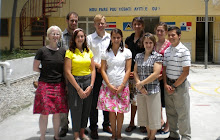

About two weeks after the earthquake, I decided to play one of my favorite games … the community Haiku. It works like this: I write the first two lines of a Haiku, and everyone else writes his or her own last line. This “post earthquake haiku therapy” has been on our wall ever since, and I still half smile and half cringe every time I read it.
The first two lines are:
Seven point zero
What the hell is going on?
The five syllable final lines are as follows … with a little explanation of each person’s earthquake experience:
Betsy: Get under the couch!
I’ve already explained that my somewhat appropriate and sort of insane instinct was to climb under the couch in our common room to wait for the shaking to stop
Mary: Should we not get out?
Mary was with me and Kristen upstairs, and while her inclination to get the hell out was probably better than mine to climb under the couch … we didn’t go anywhere.
Kristen: Please stop shaking now.
I’d say this one’s self explanatory
Elissa: Uh oh … coconuts!
She was outside walking among the mango and coconut trees and incredibly, her first thought was what would happen if one fell on her head. If you’ve never seen a coconut fall to the ground, it could kill you.
Peter: Incinerator?
He was outside dumping a wheelbarrow full of trash into the incinerator when the cinderblock walls starting moving. He thought the incinerator walls themselves were about to fall. Miraculously, only a few of the blocks actually did fall.
Samanthaa: Uh guys, get out now!
She was also near the incinerator with Peter and ran with the kids on the soccer field toward the center of the soccer field, away from the walls that were waving and crumbling.
Jon: Don’t push, pull instead.
Jon and Corey were making dinner in the kitchen and had a huge pot of water boiling on the stove. Amazingly, it didn’t completely fall off the stove. They ran for a doorway and Jon couldn’t figure out why he couldn’t get the door open …
Corey: Hold me Jon, I’m scared!
Corey the Guamanian is the only one of us who had any previous earthquake experience, so it was he who told Jon to get into a doorway.
Meg: I think we’re moving.
Meg was on the soccer field with the kids too.
John: hey guys, sorry I’m late!
John DiTillo wasn’t actually in Haiti on January 12th. He was a volunteer last year, and was safe at home in Hanibal, Missouri when the earthquake happened here. A month later, he had dropped everything at home and was back in Haiti. He’s picked up classes for volunteers who have since gotten involved in more time consuming outside of school projects. More importantly, he was a much needed shot of energy and enthusiasm at a time when we were getting pretty tired. Now he’s decided to stay on past June, and will return to LCS next fall as well. What a blessing.
About a month after the earthquake I started hearing an expression in Kreyol that sort of freaked me out a little at first, but which I have since come to understand and genuinely appreciate. One day in class I asked where a student was, and the response came, “anba dekonb” … under the rubble. I think she was really only in the bathroom or something. Subsequently, questions about “where’s your pen,” “has anyone seen my eraser,” and “where’s the truck” are all met with the same joking response … “under the rubble.” Now there’s even a Haitian DJ who mixed an upbeat tune that says, “put me under the rubble … pull me out from the rubble” and people around here sing it incessantly. It makes perfect sense to me now. Haitians are so accustomed to tragedy, but also love to laugh so much, that it’s only right that eventually there would be a collective national joke about the latest tragedy. We wrote a haiku, and they make morose jokes about being buried under the rubble. It’s the same thing really.
Sunday, April 25, 2010


Wednesday, April 7, 2010
Una Playa Bonita … y Una Presidente Por Favor!


On our first day at the resort near Santo Domingo, I kept laughing to myself thinking, “we are the ideal resort guests … because we will love EVERYTHING!” Did we throw a fit that our shower didn’t have any water for an hour or so? Nope. Were we annoyed that one of the restaurants was closed one night? Nope. We loved everything. The fancy lobby, the ocean view from our rooms (even though we had to crane our necks to the right a bit), the endless buffet, the waiters who came around and refilled our café con leche all morning, the free (I mean already paid for) cocktails … and the forks. Seriously, we were all just pretty excited to have total access to any kind of silverware we wanted at any moment of the day or night. At LCS our forks and spoons have the irritating habit of disappearing, so we end up eating spaghetti with spoons, and drinking soup with a quarter cup measuring cup. Needless to say, the endless supply of forks was pretty great. But mostly what we loved was the total relaxation of it. We didn’t have to do anything except enjoy the picturesque beach and the beautiful, friendly people. I’ve never done the “all inclusive” thing before, and I don’t think I would want to do it for a whole week, but for three days it was perfect.
After the resort we took the bus north to the Samana Peninsula, to a place called Playa Bonita. And yes, it was. There we stayed at a small hotel on a dirt road across the street from a very different, but equally beautiful beach. This one had rougher waves, but even softer sand. And there was no loud music, or people selling things, or free drinks … just the beach. We walked an hour into the little town nearby, bought sandwiches from an Italian grocery store, and rode on the backs of motorcycles back at night. We went on a horseback riding trip through mountain trails to a place called “cascada limon” where we jumped off a 30 foot ledge into the waterfall’s pool below. I can count on one hand the number of times I’ve ridden a horse in my life, and I’m SURE I’ve never been on a galloping horse. It was terrifying / awesome … but mostly awesome.
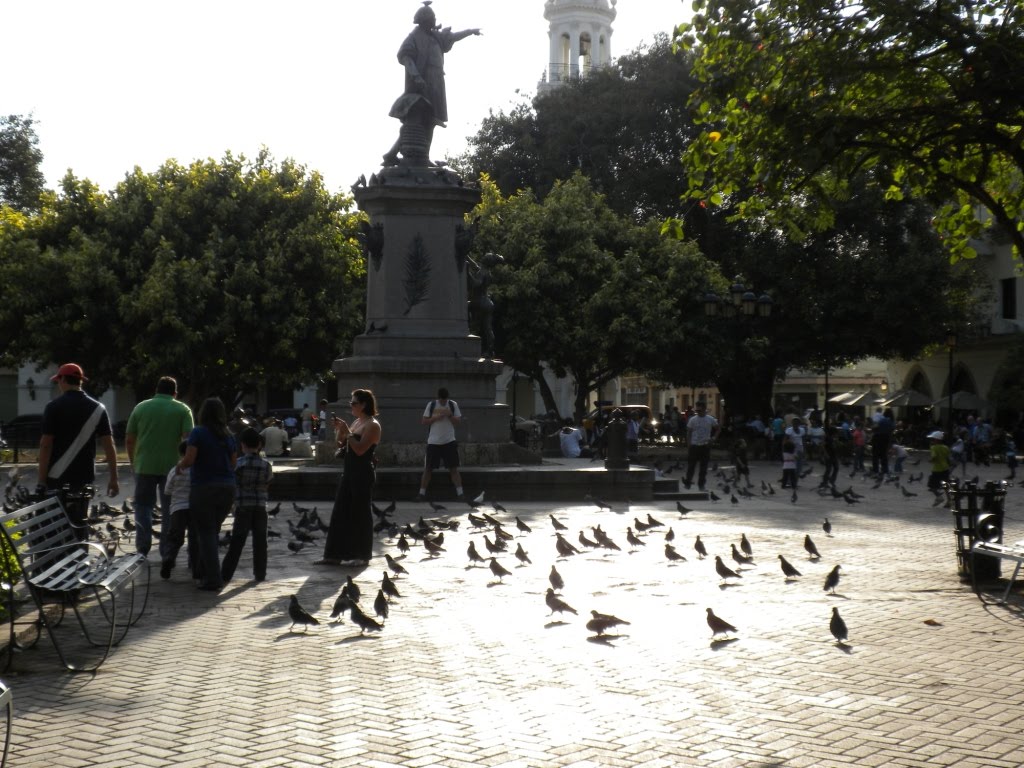
Then we scored a reasonably cheap taxi ride back to Santo Domingo (avoiding a two and half hour bus ride all together) and arrived in the capital at about noon on Friday. We stayed at a little hotel run by a German man in the zona colonial, and for the next three days I just kept thinking about Europe. There are cafes with outdoor seating, and people just sit there smoking for hours. There are motorcycles everywhere. Little kids chase pigeons in plazas in front of 500 year old churches. Only it was better than Europe because seriously, Dominicans are way more beautiful than Europeans, and it was a whole lot cheaper. We spent the days walking a lot, enjoying the freedom of being in a city. I drank lots of coffee drinks in outdoor cafes, and struck up conversations with anyone wearing a Red Sox of Yankees cap, which was lots of people.
Santo Domingo was lovely for the mix of uniquely Dominican things and the comforts of home. I went to Easter Mass at a tiny church with about 40 people in it, and instead of the Handel Alleluia and brass quintet (my usual Easter routine) there was a lady with a tambourine and about five nuns singing with her. A good reminder that, as much as I love the music, it’s not all about the music. Then for Easter dinner we did the only thing any self respecting Americans who have been in Haiti for 8 months would do … we went to McDonalds. I think a few of the boys almost cried with joy. I haven’t had a quarter pounder with cheese in years, but wow, that was tasty. Our last night, we planned to go watch the Red Sox and Yankees at a sports bar with a big screen TV, but instead stumbled upon a neighborhood dance party. We spent the evening with a few hundred people dancing Merengue and Bachata in the street while a live band and some old dudes (who could really sing) kept the crowd moving for hours. Instead of bar food we ate deep fried street food, but of course still enjoyed more than our share of the DR’s finest brew, Presidente. And much to my delight, there was a TV outside that was showing the Sox and Yankees, so all night long, I had lots of opportunities to trash talk in Spanish. How exactly do you say “Yankees suck!” in Spanish? Never quite nailed that one down. It was a perfect end to our ten day break.
The whole thing reminded me how much I love to travel. On this trip I spoke more Italian than I have in ten years (who knew there were so many Italians settling in the DR?) and I got to freak out lots of Haitians who did NOT expect the whitest person they’d ever seen to speak Spanish let alone Kreyol. I loved haggling with cab drivers, and negotiating very, VERY badly with an art dealer. Whatever. I don’t care if I overpaid. I love this painting and I feel pretty good about putting my money into the local economy. I love setting out for dinner with the plan to eat at a place recommended in a guide book only to find something way better on the way. It’s just all so fun. Can someone figure out how I can do that for a living?
Now we’re back to Haiti and LCS is up and running without missing a beat. Today, April 6, was the first official school day in Port au Prince since January 12th. The government encouraged the schools which are able to open, and there were kids in uniform all over town. We had 318 kids this morning, closer and closer to our pre-earthquake number. Today one of my absolute favorite kids was back to school for the first time. Rose Celine is about 17, and is one of the sweetest, smiley-est kids I’ve ever known. In the hours after the earthquake, hers was one of the terrified faces that drove home for me how serious this whole thing was. Gone was her smile – and the tears on her face and fear in her eyes is an image I’ll never forget. Then the next day she was gone, and I’ve wondered how she is for almost three months now. So I was so happy today to see her there in my first period Spanish class, looking a little overwhelmed but smiling nonetheless. Vacation was wonderful, but Rose Celine is back to school, so I better be here too!
Sunday, March 21, 2010
The Rainpocalypse


I know that people in the DC area lived through several feet of snow this winter, the so called snowpocalypse, and that my New England family and friends experienced 10 inches of rain last weekend and are still pumping out flooded basements. This morning, we had a rain phenomenon like nothing that has ever happened in my time here. It rained during school hours. Insert foreboding, dramatic music here.
The rainy season has begun again, which means that it rains almost every night at about 7 for a few hours, or for a while just before dawn. But it always stops by about 6 or 6:30 am, just as we’re all going outside to eat breakfast and get ready for class. This morning, it just kept raining, and literally, this was the first time in my six months here that we have had rain during school hours. If you think about most American schools, rain is no big deal. The buildings are enclosed, and once the kids get off the bus, or out of the car and run in from outside, they’ll be dry for the rest of the day. Not so much here. We have 2 classrooms that are literally outside under trees. We’re using five tents whose floors consist of a tarp over a dirt soccer field. Windows are wide open. There’s not very good drainage. We all have to walk outside to get from class to class. Oh, and we all wear sandals most days.
I of course had my first two classes of the day in one of the muddy tents. Unfortunately we HAD to open the window flaps or we would all have suffocated from the heat, but then the rain came inside. Lucky for me, I’ve been through many years of snowy days at school, so I knew enough to just let the kids spew whatever they needed to say about the rain for a while before delving into any even remotely academic work. It wasn’t pretty, but we survived. The pictures above are from the rainy morning assembly. You can’t actually tell how many kids are under that one umbrella unless you count the feet. I think there are 12 feet. The highlight of the morning however was when staff erupted into a spontaneous dance party in the rain as the kids sang the school song. That helped improve some people’s attitudes …
But in all our joking and laughing about the rain, and the inconvenience of having horrifically dirty feet all day from running around in the mud, I tried not to lose sight of the fact that there are still hundreds of thousands of people living outside in this country. Their tents generally aren’t as nice and waterproof as our classroom tents, and they don’t all have dry buildings to go into to dry off. It’s still going to be a long road for so many of them.
So what else is new?

Louverture Cleary people are doing some really amazing things out there right now, while the rest of us are holding down the fort with the kids at school.
Patrick Moynihan and Corey (one of the precocious 22 year olds around here) have been working with Catholic Relief Services and a few other agencies to open an 80 bed rehab clinic for earthquake related surgical patients. In the first days after the earthquake, there were so many amputations and some pretty incredible surgeries that happened at so many different facilities, with so many different visiting medical teams. But then those patients all went home, or to tent cities, and now the calf muscle brilliantly grafted to some other part of the leg is atrophying, and the incision sites are getting infected. So, this rehab clinic will coordinate the post surgical medical care, as well as social welfare (including helping to secure housing.) It’s an amazing project that many LCS graduates will have important roles in – as doctors, translators, drivers, and social workers. Corey and Patrick have been running all over town for weeks to make this happen, and the first post surgery patient transfers happened this week. The clinic should serve more than 500 patients in the next six months.
People have donated so much money to our relief fund, and the work of helping our staff and neighbors rebuild is in full swing. LCS staff have fixed pieces of several houses,, making them inhabitable again, and are almost done with a completely new home construction for a neighbor whose mud house was totally destroyed. Meghan, another volunteer, is the finance manager for these relief funds, and has taken responsibility for keeping track of spending, and paying our team of laborers from the neighborhood every week. In the meantime, she’s learning how to build houses, which is also pretty cool since she’s planning to study architecture in the near future.
And since the earthquake, we’ve stepped up our work with some of the neighborhood children in desperate need of supervision and care during the day. In the fall, we had our afternoon lunch and play time for 40 – 50 kids, but we realized that this wasn’t nearly enough for some. A few weeks after the earthquake, we realized that a few kids were missing. Sadly, two parents in the neighborhood had decided that they simply couldn’t care for their children anymore and had given them away to an “orphanage.” Imagine the desperation that prompts a parent to do that … It took several days of asking questions and searching to find the children, and as we feared, they were in a totally unregulated and unsanitary situation. It seems that people were basically collecting children, then soliciting money from foreigners to help renovate their “orphanage.” One can only imagine what they planned on doing with the children they had collected. In this whole ordeal, I met the absolute shadiest human being I have ever met, a man who would not tell us where the kids were, and refused to let anyone – even their mother – go to see them. Scary. Anyway, after a few days Christina Moynihan and a few of the drivers and security guys managed to literally rescue 5 children from this so-called orphanage. Unfortunately, their parents were still unwilling / unable to fully care for them, so we basically started a full day childcare program at school. Now Kristen, the volunteer with the elementary ed background, and three of the Haitian staff are teaching and caring for about 10 of the youngest neighborhood kids most in need of care during the day. Then they go home and stay with their families at night. It’s been amazing to see the transformation in some of these kids. They were sick and scared and only wanted to be held a few weeks ago, now they’re running around throwing balls at mango trees with the older kids trying to score a juicy snack.
We’re still not “officially” having school, though we never really stopped having school either. With almost three hundred kids and most of the teachers back, this place is starting to feel more and more normal, which is of course, a good thing for everyone. But for me a weird consequence of all that routine, is that I’m getting kind of bored. I’m back to teaching Spanish, and still overseeing – though not continually retooling – the academic schedule, and supervising cleanup and study, and teaching some kids Italian, and playing with the little neighborhood kids … all the things I was doing last fall. I found myself getting bored this week, and to be honest, a little jealous of the people who are out there working on the more exciting things. I knew that the adrenaline of the earthquake and its immediate aftermath would die off sooner or later as the work became less heroic and more routine, and that then the real work would begin. Well, here we are. I just keep telling myself that it’s my role now, to just help keep things running smoothly here so that other people can get out there and rebuild Haiti.
EpiDor: The Fast Food Disco
I need to describe our fast food restaurant experience last week. It was amazing – and not just for the joy of a cheeseburger, fries, a Coke and really tasty cookies ‘n cream ice cream. It was wonderful because it was a window into a small, little known segment of Haitian society – the middle class. My meal cost about 8 dollars, which is almost twice the minimum daily wage here, and certainly many people don’t earn anywhere near the minimum wage. So the people who live in our neighborhood, even the kids at LCS, are not the kind of people one is likely to find at a fast food restaurant. The only other experience I have “eating out” in Haiti is at fancy hotels where there are lots of foreigners, and lots of mostly very light skinned members of Haiti’s small, wealthy elite. I saw no evidence of this crowd at EpiDor either. Instead, it was full of people in their 20’s and 30’s, not too many families with kids, and not too many older people. There were of course some foreigners, but I think we were the only Americans. Many people were dressed as if they were going “out” – which in women generally means there was lots of visible cleavage, and in men means a well chosen, brightly colored polo shirt. Loud music was playing, creating a distinctly festive atmosphere. There wasn’t actually any dancing, but I wouldn’t be surprised at all if dancing broke out there one day. People were laughing a lot, talking to each other, seemingly flirting, and of course, drinking lots of beer along with their burgers. I recognize that Haiti has bigger problems than a lack of causal dining and meeting places, but I actually think that places like this are so important to the future of this country. There needs to be a middle ground – nicer than the food vendors on the side of the road, but not as intimidating and expensive as the hotel restaurants. I can’t believe I’m advocating for more greasy fast food restaurants as a means of economic development, but I think that’s what I’m saying.
Another amazingly Haitian thing about EpiDor – it was total dezod. Chaos. There are two cashiers at one side of the store, and people basically mob them in a crowd not even remotely resembling a line. This scene makes cafes in Rome appear to have military discipline. Lots of elbows, lots of gentle shoving, lots of violations of personal space … but at the end of the day everyone gets their food and everyone’s smiling throughout. After you pay, you get your ticket and go to another counter where there is absolutely no rhyme or reason to who’s supposed to get which food for which people. You just hand it to someone and hope she’ll get your fries eventually. Having jostled with people on the side of the road hoping that the woman selling fried plantains would deign to get me some, I know why EpiDor is the way it is – because most people’s only food buying experience is from the vendors on the roadside, so all this madness is totally normal to them.
I will say that I’ve never worked so hard for a burger, fires and a cup of ice cream in my life. But they were totally worth it.
Another amazingly Haitian thing about EpiDor – it was total dezod. Chaos. There are two cashiers at one side of the store, and people basically mob them in a crowd not even remotely resembling a line. This scene makes cafes in Rome appear to have military discipline. Lots of elbows, lots of gentle shoving, lots of violations of personal space … but at the end of the day everyone gets their food and everyone’s smiling throughout. After you pay, you get your ticket and go to another counter where there is absolutely no rhyme or reason to who’s supposed to get which food for which people. You just hand it to someone and hope she’ll get your fries eventually. Having jostled with people on the side of the road hoping that the woman selling fried plantains would deign to get me some, I know why EpiDor is the way it is – because most people’s only food buying experience is from the vendors on the roadside, so all this madness is totally normal to them.
I will say that I’ve never worked so hard for a burger, fires and a cup of ice cream in my life. But they were totally worth it.
Sunday, March 14, 2010
A Cold Monday and Hot Yoga

This is a picture of our almost completed LCS logo ... we have 270 of 350 kids back at school, and the principal, Mr Hubert (at the front) orchestrated this awesome picture to demonstrate our progress so far.
Here’s a little assortment of news from the past week. No big stories, just life.
It was cold on Monday. . I realize that “cold” is a relative term, but it was seriously chilly. Maybe it was in the sixties, but when the breeze is blowing, and no buildings are really fully closed, and the showers aren’t heated … it feels downright cold. I slept with a blanket for the first time at LCS and wore my hood up on my hoodie sweatshirt in the morning. I saw a staff member wearing a down jacket (which he has because he once traveled to the US during the winter.) Not only was it cold, but it was overcast and sort of raw for two days. Now THAT is weird. Suddenly everyone had a cold and our solar powered buildings had some challenges those days. By Wednesday we were sweating our faces off again and remembering fondly, the Monday chill. It t was a strange little interlude.
We have 270 kids back at school. Each week we (or actually I) have rearranged the schedule to accommodate the increased number of kids. The big shift happened this week when we divided three more classes into two sections instead of keeping them all together in one. The challenge there … room space. We got 7 tents from the Italian military that we set up on the soccer field to use as classrooms, replacing the 6 classrooms in our damaged Jean Jacques Dessalines classroom building. The tents are excellent … except for one thing. They’re blue. Blue does not exactly reflect heat … and since they’re sitting in the blazing sun of the soccer field, but by about 11 am they’re pretty darn unbearable. The kids whine incessantly like teenagers do … and then we do it all again the next day. It’s kind of a hilarious scene actually. There are these seven huge blue tents in two rows on the soccer field. They’re about four feet apart, so everyone can hear everything going on inside the neighboring tents. We moved the kids’ classroom benches and built blackboards to move in. Then we named them after the continents – Europe, Africa, Asia, Americas and Antarctica. But really, they all feel like Africa.
Then yesterday I discovered an excellent use for the tents in the blistering heat of the afternoon. Hot yoga. With all the plastic window flaps closed and the two doors zipped shut, it must be almost a hundred degrees in there. Perfect for some downward facing dogs. I’ve done hot yoga before in some sultry conditions, but this is something else entirely. Too bad my shower afterward was also hot since the water in the black tanks on the roof had also been sitting in the sun all afternoon.
We opened the “language of the day” store again this week. Every day the kids are challenged to speak the language of the day – English on Monday and Wednesday, Spanish on Tuesday and Thursday, and French on Friday. If they are heard practicing the language of the day by staff or the oldest students, they can receive tickets redeemable for prizes in our little weekly store. After Christmas we came back with lots of new additions to the store. We always have the school essentials like pens and pretty pencils and erasers and white out and calculators. But we now have a bunch of matchbox cars, and bracelets, and bubbles and hair accessories and legos. The kids loved it. One little girl, Willine, spent about fifteen minutes trying to decide how to spend her six tickets. She kept picking things up saying, “oh, this is so beautiful …” then moving on to the next thing. She settled on a hairbrush and a very pretty pink pencil with silver hearts on it. She was a very happy customer. Another little boy came and said that he didn’t have any tickets because he used to have ten, but they were in his house and now his house is “craze” (broken.) Bummer. I taught him my favorite expression to describe earthquake induced losses (like my pillow, a set of sheets, and a jar of cilantro). The earthquake ate it. Then I told him he’ll just have to start practicing again next week to earn lots more. Life is tough around here.
There’s a new fast food place near our neighborhood! It’s actually a little mini version of a chain called EpiDor that is part bakery and part fast food joint. They have burgers and pizza and ice cream and beer and crepes and French fries … The other ones in town are bigger, but a hassle to get to with all the traffic these days, so we’re pretty excited to go to this one that’s only a ten minute drive away tonight. I’ve never been so excited for a cheeseburger in my life.
Sunday is Pi day – 3/14. Peter decided to have a pi day math competition for the kids. Unfortunately, this is a culturally and linguistically complex little pun. First, he had to explain to them that we pronounce PI as PIE and not PEE (as they do in French.) Then he had to explain that we write the dates with the month before the date, so the date actually reads 3/14 (as opposed to 14/3 like most of the rest of the world does it. Then he had to explain what PIE is. After all that, he announced that there were some grade level appropriate geometry problems posted, and that the person who submitted the first correct answer in each class would win a piece of pie (to eat, not to throw in anyone’s face you PHA people …..) Today he spent the morning climbing trees, and about 3.14 hours later, he and Mary had produced about 3.14 mango pies – one of which we will consume at 3:14 pm. The others of which will await the kids with the correct solutions to his math problems. I love linguistically layered math puns.
And that’s about it. Two more weeks until we head out to the DR for a week of beach and cocktails with umbrellas in them. Can’t wait.
Sunday, March 7, 2010
Iron Chef Haiti: Battle Mango
I really love cooking here. I love the challenge of limited ingredients, and cooking for 20 to 30 people, and occasionally losing power or water in the kitchen. I think what I enjoy most is that when we pull off a meal that’s a little different, and particularly delicious, people appreciate it so much. There’s the added challenge of cooking for the Haitian palate and the US American palate at the same time, but I find it sort of an amusing challenge. And for the record, all you need to do to please the Haitians is make it really salty, and all you need to do to please the Americans is include as many vegetables as possible.
We decided this weekend to have a cook off between some of the Americans who most enjoy cooking - and trash talking about our culinary skills. Tonight was my turn with my teammates Peter, the master baker and rice maker and Mary the skilled sous chef. The rules of the competition were that we could only use the ingredients that we readily have available or already in our cabinets. No special trips to the supermarket or unusual expenditures. So, we decided to center our meal around the most abundant – and free – ingredient in Haiti in March: mangoes. In terms of the rest of the ingredients, we always have rice, which we get for free from Food for the Poor. The Columbian Red Cross dropped off massive quantities of lentils and red beans a few weeks ago, and we’ve been working hard to get through those. We can always get potatoes, onions, carrots and tomatoes, and we can usually get milk and butter too, so we used those basics for our mango inspired menu.
We made white rice in the normal Haitian style, except that we added a huge quantity of curry to the water to flavor the rice, and turn it a little yellow. Then we boiled and mashed lentils with garlic and more curry. We sautéed potatoes, onions and carrots in lots of garlic, salt, curry and cumin. Then to top off the rice and lentils, we made a mango chutney with mangoes, tomatoes, spicy peppers, scallions, garlic, cumin and a little vinegar. Oh my goodness it was beautiful. To drink we made mango smoothies with nothing but mangoes, milk and ice. On the side we made Indian chapote bread. For dessert we had mango cake and coffee with a little chocolate (also from the Columbians …) We fed 20 people, and probably spent about 25 cents per person. Oh yes, I forget to mention that all 30 mangoes that were used in the creation of this beautiful meal came from trees on the school campus which Peter Ulrickson climbed himself.
We started cooking at about 2:30, served the meal at about 6:15, and sat around enjoying the it until about 7:30. We called the meal “Indies: East and West” and I made a playlist of music from the movie Slumdog Millionaire, along with some of Wyclef Jean’s greatest hits. Instead of eating buffet style, we set the table and served everyone plates. There were candles and napkins and place mats. It’s just so nice to take the time once in a while to remind ourselves that there can be so much pleasure in small things. That really, just taking the time to prepare a meal, and eat it slowly makes us all feel a little more human.
And there’s not a CHANCE that tomorrow night’s team is going to make anything more amazing than what we made tonight. We’re totally gonna win.
We decided this weekend to have a cook off between some of the Americans who most enjoy cooking - and trash talking about our culinary skills. Tonight was my turn with my teammates Peter, the master baker and rice maker and Mary the skilled sous chef. The rules of the competition were that we could only use the ingredients that we readily have available or already in our cabinets. No special trips to the supermarket or unusual expenditures. So, we decided to center our meal around the most abundant – and free – ingredient in Haiti in March: mangoes. In terms of the rest of the ingredients, we always have rice, which we get for free from Food for the Poor. The Columbian Red Cross dropped off massive quantities of lentils and red beans a few weeks ago, and we’ve been working hard to get through those. We can always get potatoes, onions, carrots and tomatoes, and we can usually get milk and butter too, so we used those basics for our mango inspired menu.
We made white rice in the normal Haitian style, except that we added a huge quantity of curry to the water to flavor the rice, and turn it a little yellow. Then we boiled and mashed lentils with garlic and more curry. We sautéed potatoes, onions and carrots in lots of garlic, salt, curry and cumin. Then to top off the rice and lentils, we made a mango chutney with mangoes, tomatoes, spicy peppers, scallions, garlic, cumin and a little vinegar. Oh my goodness it was beautiful. To drink we made mango smoothies with nothing but mangoes, milk and ice. On the side we made Indian chapote bread. For dessert we had mango cake and coffee with a little chocolate (also from the Columbians …) We fed 20 people, and probably spent about 25 cents per person. Oh yes, I forget to mention that all 30 mangoes that were used in the creation of this beautiful meal came from trees on the school campus which Peter Ulrickson climbed himself.
We started cooking at about 2:30, served the meal at about 6:15, and sat around enjoying the it until about 7:30. We called the meal “Indies: East and West” and I made a playlist of music from the movie Slumdog Millionaire, along with some of Wyclef Jean’s greatest hits. Instead of eating buffet style, we set the table and served everyone plates. There were candles and napkins and place mats. It’s just so nice to take the time once in a while to remind ourselves that there can be so much pleasure in small things. That really, just taking the time to prepare a meal, and eat it slowly makes us all feel a little more human.
And there’s not a CHANCE that tomorrow night’s team is going to make anything more amazing than what we made tonight. We’re totally gonna win.
A Tale of Two Cities
My journey to Notre Dame took two days, during which I passed through three countries, two states and a US territory. When my flight from San Juan was preparing to land in Chicago, I was all irritated because it was landing almost an hour late. Then the pilot came on and said we were preparing for an early arrival. I looked at my watch, perplexed. Then I figured out that San Juan is in a time zone EAST of Eastern time, so I needed to set my watch back two hours for Chicago time. I reached in my pocket as I prepared to get off the plane to dig for money to buy a long awaited Starbucks latte, and had to dig through the Haitian Gourdes and Dominican Pesos before I found any good ol’ greenbacks. On the way back to Haiti I was amazed to discover that the journey from Chicago to Santo Domingo took about seven hours, while the bus ride the next day to Port au Prince took nine. Anyway, it was a complicated journey but so good to be at Notre Dame with many people that I love to share in a beautiful farewell to such a special person. And three days in the United States reminded me once again how much I love hot showers, and what a gift it is that we can drink the tap water.
This journey also included my first ever visit to the other side of this little island, and … I had some serious culture shock when I got there. Before I describe Santo Domingo, I need to note that Haiti and the Dominican Republic have shared so much history, but also have an extremely tumultuous relationship. I’m not much of an expert on Dominican history, though I plan to educate myself a bit more in the next few months. Here’s what I know … before Columbus arrived on this island, the native Taino people who lived here called it Ayiti, which means something about rocky ground. They lived in grass huts, in small family based communities. They fished gathered what they could from the land, and were generally peaceful among themselves. Columbus arrived and forced them to mine for gold. In less than 200 years after the arrival of the Spanish, the Taino people were all but extinct, the victims of violence and smallpox. The next three hundred years brought sugar plantations and slavery and battles between the Spanish and French over this little island which would make both European empires incredibly rich. At some point in the 1600’s, the Spanish ceded the western half of the island to the French, as part of some treaty that I can’t remotely remember the specifics of. And so, the western half of the island, Saint Domingue developed its unique culture based on French culture, slave culture, and the distant memories of Taino culture. The Eastern half of the island meanwhile developed more or less as the other Spanish colonies did. Slavery was less prominent. The Church was more powerful. And there was more mixing among the different ethnic groups on the island, creating a still diverse, but less binary racial climate. In 1804 when the former slaves successfully expelled the French for the last time, they then expanded beyond the old boarder and took over the Spanish side of the island. Though they abolished slavery, the Haitian leaders treated the Dominicans brutally, and about 40 years later, the Dominicans fought for and won their independence from Haiti. The next hundred years brought dictators, military juntas, and dubious foreign involvement to both countries. In the 1950’s, the Dominican Republic languished under the brutal rule of Rafael Trujillo while Haiti suffered under Francois Duvalier. Ironically, these two sadistic dictators hated each other, and did their best to brutalize each other’s people. And here’s where the similarities end. After the DR forced out Trujillo, something changed. While Haiti plodded along under the dictatorship of Duvalier and his hapless son until 1985, the DR was developing. While Haiti stumbled through coup after coup and unimaginable political chaos from the early 1990’s until 2006, Santo Domingo was becoming a mini Miami. I don’t know anything about the last fifty years of Dominican history, but wow … something different happened on this side of the island.
Santo Domingo is really like a little Miami. After about three hours there, I decided that I could absolutely, comfortably live there. There are six lane divided highways. There’s organized public transportation. The city is well lit at night. There are tall buildings and fast food restaurants and ice cream places and fancy hotels and dance clubs on the strip in front of the main beach front. There are families walking around with little kids at night. There’s a big plaza by the water with karaoke bars and outside seating and little kids riding bikes and couples strolling and bachata music blasting from passing cars and nearby bars. The night I got there happened to be Dominican Independence Day, and they were shooting off fireworks all along the beach in a relatively well organized (though definitely not OSHA approved) fashion. I ate the best pizza I’ve had in so long. And here’s something strange … there were a lot of overweight young people, something you just don’t see much of in Haiti. It was like being on another planet. On the one hand it made me so sad to think of people who share so much history, so close by living in such drastically different circumstances. On the other hand, it made me sort of hopeful. They’ve built this recently, after a tumultuous history. There must then be hope for Haiti. I don’t know what the development lessons are … but I hope someone does and I hope they’re in Port au Prince right now helping to plan for the rebuilding of Haiti.
This journey also included my first ever visit to the other side of this little island, and … I had some serious culture shock when I got there. Before I describe Santo Domingo, I need to note that Haiti and the Dominican Republic have shared so much history, but also have an extremely tumultuous relationship. I’m not much of an expert on Dominican history, though I plan to educate myself a bit more in the next few months. Here’s what I know … before Columbus arrived on this island, the native Taino people who lived here called it Ayiti, which means something about rocky ground. They lived in grass huts, in small family based communities. They fished gathered what they could from the land, and were generally peaceful among themselves. Columbus arrived and forced them to mine for gold. In less than 200 years after the arrival of the Spanish, the Taino people were all but extinct, the victims of violence and smallpox. The next three hundred years brought sugar plantations and slavery and battles between the Spanish and French over this little island which would make both European empires incredibly rich. At some point in the 1600’s, the Spanish ceded the western half of the island to the French, as part of some treaty that I can’t remotely remember the specifics of. And so, the western half of the island, Saint Domingue developed its unique culture based on French culture, slave culture, and the distant memories of Taino culture. The Eastern half of the island meanwhile developed more or less as the other Spanish colonies did. Slavery was less prominent. The Church was more powerful. And there was more mixing among the different ethnic groups on the island, creating a still diverse, but less binary racial climate. In 1804 when the former slaves successfully expelled the French for the last time, they then expanded beyond the old boarder and took over the Spanish side of the island. Though they abolished slavery, the Haitian leaders treated the Dominicans brutally, and about 40 years later, the Dominicans fought for and won their independence from Haiti. The next hundred years brought dictators, military juntas, and dubious foreign involvement to both countries. In the 1950’s, the Dominican Republic languished under the brutal rule of Rafael Trujillo while Haiti suffered under Francois Duvalier. Ironically, these two sadistic dictators hated each other, and did their best to brutalize each other’s people. And here’s where the similarities end. After the DR forced out Trujillo, something changed. While Haiti plodded along under the dictatorship of Duvalier and his hapless son until 1985, the DR was developing. While Haiti stumbled through coup after coup and unimaginable political chaos from the early 1990’s until 2006, Santo Domingo was becoming a mini Miami. I don’t know anything about the last fifty years of Dominican history, but wow … something different happened on this side of the island.
Santo Domingo is really like a little Miami. After about three hours there, I decided that I could absolutely, comfortably live there. There are six lane divided highways. There’s organized public transportation. The city is well lit at night. There are tall buildings and fast food restaurants and ice cream places and fancy hotels and dance clubs on the strip in front of the main beach front. There are families walking around with little kids at night. There’s a big plaza by the water with karaoke bars and outside seating and little kids riding bikes and couples strolling and bachata music blasting from passing cars and nearby bars. The night I got there happened to be Dominican Independence Day, and they were shooting off fireworks all along the beach in a relatively well organized (though definitely not OSHA approved) fashion. I ate the best pizza I’ve had in so long. And here’s something strange … there were a lot of overweight young people, something you just don’t see much of in Haiti. It was like being on another planet. On the one hand it made me so sad to think of people who share so much history, so close by living in such drastically different circumstances. On the other hand, it made me sort of hopeful. They’ve built this recently, after a tumultuous history. There must then be hope for Haiti. I don’t know what the development lessons are … but I hope someone does and I hope they’re in Port au Prince right now helping to plan for the rebuilding of Haiti.
Friday, February 26, 2010
Memory Eternal, Gail!
On Saturday I’ll be leaving Haiti for a few days to attend the funeral of Dr. Gail Walton, one of my most important teachers and mentors from Notre Dame. Gail was the director of Music at the Basilica of the Sacred Heart at Notre Dame, and the director of the Liturgical Choir, the group that I sang with all four years of college. She was suffering from leukemia and died on Wednesday from complications after a bone marrow transplant. I’ve written many pages of memories and reflections on how important she was for me and so many others in our journeys into adulthood, but I’ll keep it short here.
I joined the Liturgical Choir in the first weeks of my first year at Notre Dame, and in the following four years I discovered a passion, learned a whole set of new skills, developed some reasonably well informed opinions about sacred music, grew into a more adult understanding of my Faith, formed some of the most important friendships of my life, worked really hard, and had so, so much fun. Gail was an incredibly accomplished musician who somehow tolerated – or rather seemed to enjoy – leading a choir of 60 eager but not all well trained undergraduate singers. I don’t know how she got us to sing the complex music we sang as well as we sang it … except that she was just an incredible teacher. I couldn’t read music and didn’t know a fermata from a subito piano when I started singing with Gail, but fifteen years later I’m still singing some of that same music with my choir in Cambridge, and even have a lot of it memorized from when I learned it with Gail. She taught us to appreciate the liturgical significance of the music we were singing and to approach our music ministry with so much care and respect. She knew that while the Sunday morning Masses at the Basilica might become routine for us, that each Mass brought first time visitors and prospective students and returning alumni and people who were suffering or searching, and that it would be our music that would help them to pray more deeply. We knew we were ministers, not performers, and because of this she demanded excellence.
Beyond music, over the years Gail shepherded hundreds of undergraduates through that often tumultuous transition through college into adulthood. She was sometimes one of us – laughing along with our jokes, and standing with us flipping burgers at pre-game concession stands. But she was just as often the adult voice of reason helping us with the difficult decisions, challenging us to be better than we thought we could be, cheering along with all of our success, and helping us pick up the pieces when we screwed it all up. I will always treasure the memories of making beautiful music with Gail, and I will always be grateful for her guidance and friendship in these past fifteen years. I have no doubt that Gail Walton’s kindness and passion and hard work set an example for me that helped me become who I am today.
In the years after college I stayed in close contact with Gail. I would see her every time I was on campus, and at so many weddings of choir friends all over the country. She always responded to e-mails, even the ones that were just to say hi. I saw Gail back in June at Notre Dame at my 10th reunion, and told her that I would be spending the next school year in Haiti as a volunteer teacher. While many people struggled to make sense of that decision at this point in my life, Gail just smiled and said how proud she was – followed immediately by all the motherly questions about safety and security. Throughout the next few months, every time I sent an e-mail update from Haiti she always responded with a quick line or two of encouragement and support. After the January 12 earthquake one of the first e-mails I received was from Gail, offering her thoughts and prayers, even as she herself was suffering so much.
When I got the news that Gail was in her last days, I really struggled with the decision of whether or not I would make the complicated trip from here to South Bend to be with her family and the legions of choir people at her funeral. I knew that I wanted to be there more than anything, but I felt sort of guilty even thinking about spending so much money and time away from my work here. I know that funerals are for the consolation of the living rather than any benefit for the dead, so it just seemed sort of selfish for me to consider going. So I decided I wouldn’t go. Instead, I told myself that I would stand in solidarity with some of my colleagues here and the thousands and thousands of Haitian people who didn’t have the privilege of attending funerals when buildings collapsed on their loved ones last month. I decided that like them, I would just have to find a different way to say goodbye.
And I stuck with that decision for approximately four hours … during which time I realized exactly how much I need to be there. I’ll make the journey through Santo Domingo (since commercial flights are not flying regularly out of Port au Prince yet) and I’ll arrive in Chicago with my one hoodie sweatshirt and 1 pair of close toed shoes and hope there’s not a blizzard going on. I still don’t feel quite right about taking such obvious advantage of the privileges of wealth and my American passport, but I know it’s what I need to do. It makes me smile to think about the music that we’ll sing, and the choir reunion the likes of which will never happen again. It will be beautiful – and for once Gail won’t have to be in charge of every note and every cue and every cutoff. This time, she’ll just sit back and enjoy it all. As the Orthodox Christians say - Memory Eternal, Gail!
I joined the Liturgical Choir in the first weeks of my first year at Notre Dame, and in the following four years I discovered a passion, learned a whole set of new skills, developed some reasonably well informed opinions about sacred music, grew into a more adult understanding of my Faith, formed some of the most important friendships of my life, worked really hard, and had so, so much fun. Gail was an incredibly accomplished musician who somehow tolerated – or rather seemed to enjoy – leading a choir of 60 eager but not all well trained undergraduate singers. I don’t know how she got us to sing the complex music we sang as well as we sang it … except that she was just an incredible teacher. I couldn’t read music and didn’t know a fermata from a subito piano when I started singing with Gail, but fifteen years later I’m still singing some of that same music with my choir in Cambridge, and even have a lot of it memorized from when I learned it with Gail. She taught us to appreciate the liturgical significance of the music we were singing and to approach our music ministry with so much care and respect. She knew that while the Sunday morning Masses at the Basilica might become routine for us, that each Mass brought first time visitors and prospective students and returning alumni and people who were suffering or searching, and that it would be our music that would help them to pray more deeply. We knew we were ministers, not performers, and because of this she demanded excellence.
Beyond music, over the years Gail shepherded hundreds of undergraduates through that often tumultuous transition through college into adulthood. She was sometimes one of us – laughing along with our jokes, and standing with us flipping burgers at pre-game concession stands. But she was just as often the adult voice of reason helping us with the difficult decisions, challenging us to be better than we thought we could be, cheering along with all of our success, and helping us pick up the pieces when we screwed it all up. I will always treasure the memories of making beautiful music with Gail, and I will always be grateful for her guidance and friendship in these past fifteen years. I have no doubt that Gail Walton’s kindness and passion and hard work set an example for me that helped me become who I am today.
In the years after college I stayed in close contact with Gail. I would see her every time I was on campus, and at so many weddings of choir friends all over the country. She always responded to e-mails, even the ones that were just to say hi. I saw Gail back in June at Notre Dame at my 10th reunion, and told her that I would be spending the next school year in Haiti as a volunteer teacher. While many people struggled to make sense of that decision at this point in my life, Gail just smiled and said how proud she was – followed immediately by all the motherly questions about safety and security. Throughout the next few months, every time I sent an e-mail update from Haiti she always responded with a quick line or two of encouragement and support. After the January 12 earthquake one of the first e-mails I received was from Gail, offering her thoughts and prayers, even as she herself was suffering so much.
When I got the news that Gail was in her last days, I really struggled with the decision of whether or not I would make the complicated trip from here to South Bend to be with her family and the legions of choir people at her funeral. I knew that I wanted to be there more than anything, but I felt sort of guilty even thinking about spending so much money and time away from my work here. I know that funerals are for the consolation of the living rather than any benefit for the dead, so it just seemed sort of selfish for me to consider going. So I decided I wouldn’t go. Instead, I told myself that I would stand in solidarity with some of my colleagues here and the thousands and thousands of Haitian people who didn’t have the privilege of attending funerals when buildings collapsed on their loved ones last month. I decided that like them, I would just have to find a different way to say goodbye.
And I stuck with that decision for approximately four hours … during which time I realized exactly how much I need to be there. I’ll make the journey through Santo Domingo (since commercial flights are not flying regularly out of Port au Prince yet) and I’ll arrive in Chicago with my one hoodie sweatshirt and 1 pair of close toed shoes and hope there’s not a blizzard going on. I still don’t feel quite right about taking such obvious advantage of the privileges of wealth and my American passport, but I know it’s what I need to do. It makes me smile to think about the music that we’ll sing, and the choir reunion the likes of which will never happen again. It will be beautiful – and for once Gail won’t have to be in charge of every note and every cue and every cutoff. This time, she’ll just sit back and enjoy it all. As the Orthodox Christians say - Memory Eternal, Gail!
Wednesday, February 24, 2010
School - A Shaky Start
After the earthquake, the government announced that schools would be officially closed for a month. Certainly many schools were incapable of opening due to severe physical damage. Many schools lost students and teachers – some who were killed, and others who left the city for the relative safety and calm of the provinces. The government ministry responsible for education was also decimated – its physical building collapsed and many of the people inside it buried in the rubble. And of course, there was the psychological trauma that everyone was dealing with. So a mandatory closure of all schools in the region for a period of time seemed reasonable to give everyone time to pull themselves together and reorganize.
At LCS we didn’t have any classes at all for a week after the earthquake. But once engineers had pronounced most of our buildings safe, we moved forward with a “para-curricular” school program. I put my well tested scheduling skills to work and devised a shortened school schedule utilizing only the buildings we had available, with only the residential staff as teacher (not the visiting professors who normally come work for a few hours each day). The kids didn’t wear their uniforms, and we didn’t have grades or move on with the standard curriculum. Instead we used that time to get back into some kind of routine, since everything we know about kids after disasters says that the return to normalcy is the best medicine. The student population changed each week – sometimes even day to day – but we carried on as best we could with whomever was here each day.
A month came and went, and we heard little from the government about the future of schools, so we decided to “officially” open school this past Monday after the traditional holiday week of Carnaval. Sure enough, the Friday before, the government announced that schools were not ready to reopen, and that no school – public or private – should do so until more schools were able to begin again. The primary arguments against allowing some schools to reopen were based on solidarity, and equity. There is a perception that if some kids go to school again while others are unable, that it will unfairly position them for success on the state exams. The solidarity argument is simply that everyone’s in this together and needs to stay in it together. Honestly, despite the fact that I almost always support arguments based on solidarity and equity, I think this argument is absurd. By that logic, no one should begin rebuilding their house until everyone can. No one should reopen their store until everyone can. No one should stop living outside until everyone does. So we should all just sit on the rubble and wait … and wait … and wait in solidarity for the magical cure for all our problems that’s never going to come. The solutions will come when individuals – on their own or with the assistance of the government and all the international aid organizations – take those first steps toward normalcy. I’ve seen more and more people out rebuilding their walls. I’ve seen teams of people in the streets of Port au Prince wearing USAID T-shirts cleaning up trash. More and more stores, restaurants and even a few nightclubs downtown are reopening. With each of these small actions – individual and collective – people begin to see a way out. Why can’t it be the same for the schools? Young people in school uniforms are a great source of pride for people of all social classes in Haiti, since public and private schools at all levels require uniforms. They have always been a sign of hope for a better future – not just for the students themselves but for their families and for the whole country. Wouldn’t the sight of kids in uniforms bring much needed hope at a time like this?
So, we opened school anyway. We backed off on wearing uniforms so as not to attract too much attention, but our professors were willing to come back and we announced to the kids that grades were back, and that the 2nd quarter (which should have ended after the third week in January) would end after the first week in March. On Sunday afternoon at 4 pm, we had the usual gathering of all of the kids at the end of the weekend, and we had 237 students, the most we’ve had since the earthquake. There was a very normal excitement and noise level all afternoon, as there is every Sunday afternoon. The kids crowded into dorm rooms (since some of their usual rooms are in buildings that are not usable yet), and even dug out their notebooks during the evening study hours to begin preparing for classes once again. It all felt so wonderfully routine.
Then at 4:30 in the morning we were all shaken awake by the largest aftershock we’ve felt in a few weeks. ARE YOU FREAKING KIDDING ME? There were nervous screams – distinct from the screams of actual terror from the first earthquake – as kids and adults ran outside in their pajamas and assembled on the basketball court. There was no damage, and everyone was OK. Mr. Pierre the principal even joked about being careful to check for “pu pu” on the ground on the way back, in case anyone had – um – had a fear induced accident. The kids all laughed, and though we got an earlier than usual start, we went about the morning as normally as possible, despite some of that old anxiety lingering in the back of everyone’s mind.
The school day went as well as could be expected. I had to laugh to myself as I repeated a mantra in my head that has helped me maintain sanity for many years of working in a forward thinking school …”change is hard … people fear change … change is like death ….” Teachers were confused with the new schedule, and couldn’t understand why we hadn’t just gone back to the old pre-earthquake schedule. Some kids didn’t think we should be starting again at all. And of course, despite my best estimations, the schedule I devised had to be almost completely reworked for the following day. A few of the classes have more than 40 kids in them, so instead of keeping each class in one section, we had to split them into two. While this isn’t terribly complex in terms of the schedule itself, I’m not so sure where we’re going to put these new classes, since six of our classrooms are in a building that needs some serious work before it will be structurally sound enough to hold classes again. We’re working on getting classroom sized tents … or maybe for a while they’ll just have to sit under a tree somewhere. Actually, now that I think of it that might not be so bad … there are thousands of mangoes about ready to fall from those trees!
Now it’s Wednesday, and after significant aftershocks on two subsequent nights, many kids – typically at the urging of their parents – have decided to go home. We have about 160 lefft, but that’s down by almost 80 from Monday morning. It’s incredibly frustrating. I don’t mean to be melodramatic here, but sometimes it honestly feels like we’re fighting some cosmic battle between order and chaos. We’re scratching and clawing and fighting to maintain order here, and the chaos outside just keeps coming. Not chaos in the social or political sense, but in a deeper, almost spiritual sense. Despite all the rational explanations about aftershocks, people continue to insist that these two in a row must mean that another “big one” is coming. The radio spouts inflammatory rhetoric about not going back into any buildings (regardless of their structural integrity) for another month. The government insists on keeping schools closed. These kids are so smart, and after a few weeks and so many explanations and conversations about it all, they were on board. They were laughing and playing basketball again and sleeping inside and getting their friends to come back to school. Now the fear is back and the same old questions are back and lots of kids are going home where they’ll sleep outside in tents instead of inside our perfectly safe buildings. Some days it definitely feels like the chaos is winning.
At LCS we didn’t have any classes at all for a week after the earthquake. But once engineers had pronounced most of our buildings safe, we moved forward with a “para-curricular” school program. I put my well tested scheduling skills to work and devised a shortened school schedule utilizing only the buildings we had available, with only the residential staff as teacher (not the visiting professors who normally come work for a few hours each day). The kids didn’t wear their uniforms, and we didn’t have grades or move on with the standard curriculum. Instead we used that time to get back into some kind of routine, since everything we know about kids after disasters says that the return to normalcy is the best medicine. The student population changed each week – sometimes even day to day – but we carried on as best we could with whomever was here each day.
A month came and went, and we heard little from the government about the future of schools, so we decided to “officially” open school this past Monday after the traditional holiday week of Carnaval. Sure enough, the Friday before, the government announced that schools were not ready to reopen, and that no school – public or private – should do so until more schools were able to begin again. The primary arguments against allowing some schools to reopen were based on solidarity, and equity. There is a perception that if some kids go to school again while others are unable, that it will unfairly position them for success on the state exams. The solidarity argument is simply that everyone’s in this together and needs to stay in it together. Honestly, despite the fact that I almost always support arguments based on solidarity and equity, I think this argument is absurd. By that logic, no one should begin rebuilding their house until everyone can. No one should reopen their store until everyone can. No one should stop living outside until everyone does. So we should all just sit on the rubble and wait … and wait … and wait in solidarity for the magical cure for all our problems that’s never going to come. The solutions will come when individuals – on their own or with the assistance of the government and all the international aid organizations – take those first steps toward normalcy. I’ve seen more and more people out rebuilding their walls. I’ve seen teams of people in the streets of Port au Prince wearing USAID T-shirts cleaning up trash. More and more stores, restaurants and even a few nightclubs downtown are reopening. With each of these small actions – individual and collective – people begin to see a way out. Why can’t it be the same for the schools? Young people in school uniforms are a great source of pride for people of all social classes in Haiti, since public and private schools at all levels require uniforms. They have always been a sign of hope for a better future – not just for the students themselves but for their families and for the whole country. Wouldn’t the sight of kids in uniforms bring much needed hope at a time like this?
So, we opened school anyway. We backed off on wearing uniforms so as not to attract too much attention, but our professors were willing to come back and we announced to the kids that grades were back, and that the 2nd quarter (which should have ended after the third week in January) would end after the first week in March. On Sunday afternoon at 4 pm, we had the usual gathering of all of the kids at the end of the weekend, and we had 237 students, the most we’ve had since the earthquake. There was a very normal excitement and noise level all afternoon, as there is every Sunday afternoon. The kids crowded into dorm rooms (since some of their usual rooms are in buildings that are not usable yet), and even dug out their notebooks during the evening study hours to begin preparing for classes once again. It all felt so wonderfully routine.
Then at 4:30 in the morning we were all shaken awake by the largest aftershock we’ve felt in a few weeks. ARE YOU FREAKING KIDDING ME? There were nervous screams – distinct from the screams of actual terror from the first earthquake – as kids and adults ran outside in their pajamas and assembled on the basketball court. There was no damage, and everyone was OK. Mr. Pierre the principal even joked about being careful to check for “pu pu” on the ground on the way back, in case anyone had – um – had a fear induced accident. The kids all laughed, and though we got an earlier than usual start, we went about the morning as normally as possible, despite some of that old anxiety lingering in the back of everyone’s mind.
The school day went as well as could be expected. I had to laugh to myself as I repeated a mantra in my head that has helped me maintain sanity for many years of working in a forward thinking school …”change is hard … people fear change … change is like death ….” Teachers were confused with the new schedule, and couldn’t understand why we hadn’t just gone back to the old pre-earthquake schedule. Some kids didn’t think we should be starting again at all. And of course, despite my best estimations, the schedule I devised had to be almost completely reworked for the following day. A few of the classes have more than 40 kids in them, so instead of keeping each class in one section, we had to split them into two. While this isn’t terribly complex in terms of the schedule itself, I’m not so sure where we’re going to put these new classes, since six of our classrooms are in a building that needs some serious work before it will be structurally sound enough to hold classes again. We’re working on getting classroom sized tents … or maybe for a while they’ll just have to sit under a tree somewhere. Actually, now that I think of it that might not be so bad … there are thousands of mangoes about ready to fall from those trees!
Now it’s Wednesday, and after significant aftershocks on two subsequent nights, many kids – typically at the urging of their parents – have decided to go home. We have about 160 lefft, but that’s down by almost 80 from Monday morning. It’s incredibly frustrating. I don’t mean to be melodramatic here, but sometimes it honestly feels like we’re fighting some cosmic battle between order and chaos. We’re scratching and clawing and fighting to maintain order here, and the chaos outside just keeps coming. Not chaos in the social or political sense, but in a deeper, almost spiritual sense. Despite all the rational explanations about aftershocks, people continue to insist that these two in a row must mean that another “big one” is coming. The radio spouts inflammatory rhetoric about not going back into any buildings (regardless of their structural integrity) for another month. The government insists on keeping schools closed. These kids are so smart, and after a few weeks and so many explanations and conversations about it all, they were on board. They were laughing and playing basketball again and sleeping inside and getting their friends to come back to school. Now the fear is back and the same old questions are back and lots of kids are going home where they’ll sleep outside in tents instead of inside our perfectly safe buildings. Some days it definitely feels like the chaos is winning.
Saturday, February 20, 2010
Helping - why is this so complicated?


Shouldn’t it be simple to help people in desperate need? There has been such an outpouring of support from around the world, billions of dollars and tons and tons of donations without thousands of aid workers and volunteers on the ground. It’s amazing to watch first hand, how incredibly complicated this is. It can be done well, and it cone be done so badly – even with the best of intentions.
First, how do you distribute food? How do you know who really needs it most, and how do you ensure that they get it? I know the TV has been full of images of riots over food thrown from the back of a truck, and police shooting people suspected of stealing that food, and I’ve seen glimpses in person of what that looks like. Even in our little neighborhood this morning a truck pulled up with some bottled water and bags of rice and our normally subdued and peaceful neighbors went a little crazy, yelling and pushing each other to get to the truck first. It’s strange because most of them are not actually worse of now than they were before the earthquake, so honestly that same thing probably would have happened two months ago if a truck full of free stuff had pulled up. But certainly in the tent cities there is a much more acute need, and sense of desperation, so when the food comes to the those places the reaction is even more intense.
I’ve seen food distributed really well too. The US military lines people up on a huge field, then releases them a few at a time to walk across another field to the place where the bags of rice are being handed out. Then tap taps wait on the other side to drive the people and their huge bags of rice home. Of course there are guys standing guard over the line with automatic weapons, so that helps maintain order, but the whole thing looks calm and dignified. The Missionaries of Charity are my favorites though. They have been here so long, that they know who really needs the food. They go out into the neighborhood and the tent cities and hand out tickets with a date and time stamped on them. People with the tickets then come to their door, and they only allow the ones with the [roper ticket into the compound. Then they each receive a bag with all the staples – rice, beans, cornmeal, soap, crackers, oil, and bulgur wheat. I’ve helped in the packaging and distribution of that food, and it’s a totally peaceful, dignified process. People smile and say thank you. Most of the people who come are women, the ones likely to be caring for their family, whereas most of the food riots you see on TV are battles among young men. Butt even the sisters say it’s hard when they go out into the tent cities and bring prepared food directly to the people there. They don’t know everyone, and the desperation is so acute, that they often need help controlling the crowds. But this is their mission, to serve the poorest of the poor, and they are doing it with as much love and tenacity now as they ever have before.
At LCS we decided early on that we would not become a large scale food distribution site, but rather would follow more in the example of the Missionaries of Charity and St. Vincent de Paul and bring assistance directly to the people in need. In the days after the earthquake that meant setting up a huge pot of rice and beans on the street and serving it directly to our neighbors who came by and ate it, then handed their spoon and bowl to someone else who hadn’t received any yet. That worked pretty well for a week, but it was never a long term solution. Now we’re back to feeding the neighborhood children at the school, as we always have. But since we’re a well established organization, many individuals and some of the larger aid organizations are beginning to turn to us to help figure out how to get help to the people who need it. The Red Cross of Colombia just made a huge drop off of food and supplies to LCS this week. We spent Thursday sorting the food into study shopping bags with brightly colored cartoon characters on them. Then on Friday we handed one bag to each student on his or her way out the door, and personally delivered them to families in the neighborhood, and some of the hardest hit families even beyond our immediate neighbors. There was no drama, or pushing, or yelling, or fear. Everyone got one. Now I think one of my first Spanish classes next week will need to be focused on reading the labels ad directions on some of this food that the families are a little less familiar with …
And how do you prioritize what to do first? Of course our first priority is caring for our own students and neighbors. We’ve also worked downtown excavatig the Cathedral, but then our focus shifted to one of the few functioning hospitals. While we were able to provide some actual medical help in the form of LCS graduates who are medical students, and current students to work as translators, one of our main roles at the hospital became … surprise, surprise … managing the trash. I’ve noted in the past my newfound appreciate for waste management, but this is a whole new thing. What do you do with the medical waste when the incinerator that usually burns the trash collapsed in the earthquake, and the national trash company that usually picks up the trash is a little overextended right now? We burn the trash ourselves. I’ve never personally participated in this oh so glamorous activity, but the stories of rats the size of cats are enough to give me a pretty good sense of what that’s like.
Where do you start on the physical reconstruction? The “monuments” to the earthquake are everywhere, and I worry that the longer the piles of rubble and broken buildings sit there, the more normal they will become. And once people stop noticing them, then the urgency to remove them will disappear. This is the same lack of urgency that lets people walk past piles of trash in the street here without blinking, and if the rubble problem becomes like the trash problem, then this country will not move forward. So, in our own neighborhood we’ve worked hard to clean up our own rubble, and encourage neighbors to do the same. We’ve even started paying a team of unemployed young men from the neighborhood to do some of that work. They cleaned up a large, destroyed house on a prominent corner, and are now helping to build a foundation, and eventually a house, for another neighbor who lost everything. Even the little kids in the school were helping this week, carrying cement blocks in wheelbarrows, and even on their heads, from our own pile of rubble to the site of the new house where they were being used in the foundation. After this house is constructed, we’ll move on to another one.
I’m hearing all the weird stories about utterly useless things that have been donated and shipped halfway around the world. And I’ve felt the frustration as I sit in gridlocked traffic in a line of cars bearing the logos of prominent NGO’s … each with one person inside. But I honestly don’t know enough about international aid organizations and disaster relief to offer any real criticism or analysis of what’s gone on here, and how it all could have been managed better. I just think that for myself,if I’m ever looking to make a contribution to assist people after a disaster, I think I’ll give it to the Missionaries of Charity. They know who needs the help most, and they know how to distribute it.
A different planet called Belo


I know that I’ve mentioned a place called Belo in past blog posts, but I don’t think I’ve ever really described it or posted pictures of it. Given the image of Haiti that most people – including myself – have always had, especially post-earthquake, I just want everyone to know about Belo. This place is inching higher and higher on my list of favorite places on Earth every time I visit. When I tell Haitians about visiting a little place called Belo, they have no idea what I’m talking about. To give people a clue, you have to mention the bigger tiny town nearby, about thirty minutes farther down the mountain. Even if they know that town, most have never been there or anywhere like it. When I show the kids at school pictures of Belo, many can’t even believe it’s Haiti, since they themselves have never been to such a remote, mountainous place.
Belo is barely even a town – it’s more of a truck stop at the end of a rutted, windy dirt road on the top of a mountain south of Port au Prince. A few trucks come and go each day, to drive workers the two and a half hours down to the city, and transport goods back up to the people who live in tiny houses scattered throughout the mountainside. There are a few large landowners up there as well – our friend Patrick Brun is one of them – and they have worked hard in the past nine years to replant trees in the largely deforested region. Amazingly, in such a short time, trees are thriving, and the soil is improving with it. The primary mode of transportation around Belo is walking – or sometimes riding horseback – and the primary mode of transporting goods is by carrying them on one’s head. It’s cold in Belo, in the low sixties at night, and often misty by day as the clouds swirl around among the mountaintops. There are no mosquitoes in Belo and the stars at night are brighter and night sky has more depth than any I have ever seen. People in Belo are incredibly friendly in that way that small town people around the world always seem to be, especially when compared with their more jaded and suspicious countrymen who live in the crowded cities. They wave and smile and don’t ask for money, and they absolutely do not speak one word of English. Every time we come, they always seem somewhat amused and intrigued by the carload of blan arriving from the city. However, the best thing of all about Belo these days, is that the violent fingerprints of the earthquake are nowhere to be found.
Of course the people in Belo felt the earthquake. It’s actually much closer to the epicenter in terms of miles, but the elevation (more than 6,000 ft) seems to have cushioned them from most of the shaking and destruction. One man explained to me that some small houses were destroyed, but that everyone from the area who actually died during the quake was killed in the city, not in Belo. Mr. Brun’s house is simple and well constructed, and the only damage his house sustained was some broken glasses that fell from a shelf and a large granite table on the back patio that tipped over. When we made the turn off the paved road onto the dirt road about 45 minutes from Belo, we saw fewer and fewer piles of rubble and collapsed houses, those sad remnants we have termed “monuments” to the earthquake. There are no tent cities or UN trucks, or traffic, and the thin mountain air refreshes the body and spirit in equal parts.
What is there to do in Belo? Nothing really, and that’s why it’s wonderful. We’ve gone there a few times, always a collection of volunteers, staff and Moynihans, but this time we went alone, just the volunteers. This week was supposed to be a vacation week in the country in celebration of Carnaval, and we had plans to spend it in the DR sipping cocktails with umbrellas in them on a beach somewhere. But Carnaval didn’t happen, and traveling is still complicated, and it just didn’t feel right to party it up in the DR while people here are still digging out. So instead we opted for two nights at the Bruns’ house in the mountains of Belo. We played Chinese checkers sitting in the sun on the patio, read a lot, went on long walks in the hills, and spent tons of time cooking and eating. It was nice to sleep a little later, lounge around in our PJ’s, curl up under blankets on the couch and watch the clouds roll in and out. We grilled chicken and potatoes that Bernard, the caretaker of the house, literally dug out of the ground for us. In the morning he brought us some freshly laid eggs, and we enjoyed the tastiest omelet I’ve ever eaten. At night we built a huge fire in the outside fireplace and made s’mores while sipping Barbancourt rum and Cokes.
On one of our walks we journeyed to a nearby hotel that we had heard has a restaurant, but when we got there we were informed that it was closed for the season until March. But since one of the gates was close with only a coat hanger … we decided to do a little exploring anyway. It was the strangest place! It was sort of a cross between the hotel from The Shining and the family summer camp from Dirty Dancing. There were little cabins, and well maintained gardens, and a big outdoor pavilion with a creepy Phantom of the Opera chandelier. There was a restaurant with a patio for outdoor seating, a soccer field, some horses, and the ugliest, mangiest dog I’ve ever seen in my life. Men were working on the grounds, and smiled and waved as we walked around, but other than that it was totally deserted. Eerie. I imagine that people must come there, and one of the caretakers explained to me that in the summer there are lots of big parties and weddings there. I think it must be really beautiful, and it gave me a glimpse into the tourist industry that this country could have … if visitors didn’t have to pass through the trash piles of Port au Prince in order to get here. Maybe if Haiti rebuilds right and foreigners invest, then tourists will come. I hope so. I’d love to come back to Belo with friends some day.
Subscribe to:
Posts (Atom)